
Abstract
Foreign aid is often viewed as one coherent structure, but two financial architectures now fund the developing world: the traditional Western model of the Organisation for Economic Co-operation and Development (OECD), which uses grants and multilateral organisations, and an emerging model led by China along with Türkiye, India and the Gulf states, which uses bilateral loans and state-directed finance. Which offer is better has become a contested question in development economics. Research on aid effectiveness concentrates almost entirely on Western donors, while scholarship on non-Western donors remains confined to single-country studies. This paper compares the two categories using OECD reporting and AidData’s record of Chinese lending, examining economic growth, association, infrastructure development and the militarisation of aid, with China and Türkiye representing the non-Western cases. It finds that Western aid delivers substantial welfare gains but is increasingly dominated by emergency spending, that Chinese finance expands infrastructure while increasing debt burdens and offering limited transparency, and that Turkish aid allocates assistance primarily according to shared identity. The paper concludes that the two categories operate on different margins and the available data does not support a ranking between them; it then draws out the implications of these findings for the literature, donors, lenders and recipient governments.
1. Introduction
Consider a finance minister deciding between two competing offers of development finance. In the first case, a Western donor offers the finance minister a grant. The money comes with governance conditions attached, and officials will return periodically to check that they are being met. In the second case, a non-Western donor offers him loans for infrastructure, promising fewer political conditions and a shorter wait. These contrasting approaches represent the two models of contemporary foreign aid.
Foreign aid is usually discussed as though it were a single structure, but two different systems now compete to fund the developing world. The first, the traditional system, was built by the United States and Western Europe after 1945 with the Marshall Plan and institutionalised through the Organisation for Economic Co-operation and Development (OECD). The other emerging system is led by China and joined by non-Western nations such as Türkiye, India and the Gulf states. In this paper, “Western countries” refers primarily to the members of the OECD’s Development Assistance Committee (DAC), particularly the United States, France, Germany and the United Kingdom. The DAC is a committee within the OECD comprising 33 members that report Official Development Assistance (ODA), the OECD’s standard measure of foreign aid. “Non-Western countries” refers to providers of development finance operating outside the DAC aid system.
This paper’s purpose is to juxtapose Western and non-Western foreign aid using consistent measures so that their real differences become visible, weighing their effectiveness and shortcomings by examining two non-traditional donors in depth: China and Türkiye. It proceeds from the existing literature, through the aggregate data on how much Western and non-Western powers provide, and then to a structured discussion of how the two models compare on economic growth, association, infrastructure development and militarisation.
2. Literature Review
Older literature, centred on Western donors, primarily examines whether foreign aid is effective. The early empirical results produced inconsistent outcomes. Boone (1996) found that foreign aid increased consumption and not investment, while Burnside and Dollar (2000) suggested that foreign aid would promote economic growth only where good policies had already been implemented. More recent empirical studies have been equally divided. Some find little to no effect of aid on economic growth (Rajan & Subramanian, 2008), whereas others demonstrate the ability of foreign aid to stimulate investment, growth and long-term development when viewed through correct time perspectives and improved methodology (Clemens et al., 2012; Arndt et al., 2015). Sachs (2005) believes that large amounts of foreign aid can help countries escape the poverty trap, while Easterly (2006) and Moyo (2009) believe that foreign aid does not work because it creates dependence and poor planning. Banerjee and Duflo (2011) dismiss these comparative approaches entirely, believing that foreign aid cannot be assessed universally, an approach whose methodological standing was reinforced when the 2019 Nobel-recognised experimental evaluation in development economics (UNU-WIDER, 2019).
The literature on non-Western aid is much younger and faces a distinct challenge, since its subject is less readily observable. While China finances its infrastructure projects through large loans, Türkiye concentrates on humanitarian aid and refugee help, the Gulf countries engage in political aid and India gives fairly small credits related to exports (Neumayer, 2003; Villanger, 2007; Parks et al., 2025; Asmus-Bluhm et al., 2025). As China dominates the category by volume, “non-Western aid” is often shorthand for Chinese aid.
The literature on Chinese aid developed in two phases. The first one was largely argumentative: Naím (2009) referred to Chinese aid as “rogue”, untied from needs and corrosive for the Western norms; Woods (2008) disagreed, stating that China provided an alternative financing option but not a replacement of the current system; Bräutigam (2009, 2011) proved that Chinese financing relied on the long-standing tradition of export credits and resource-backed loans and thus was not as innovative as it was said. The second phase began when accurate data on Chinese financing became available, moving the literature from theorising to empirical analysis. With AidData’s analytical framework, it was possible to establish project-level flows of China. Dreher and Fuchs (2015) largely rejected the concept of “rogue aid”, while Dreher et al. (2022) produced the field’s main growth estimate. Recent studies covered such topics as regional preferences of leaders (Dreher et al., 2019), corruption close to projects (Isaksson & Kotsadam, 2018), stability in comparison with World Bank projects (Gehring et al., 2022), regional redistribution (Bluhm et al., 2025), and loan conditions and secrecy (Horn et al., 2021). Within this stage, scholarship increasingly challenged the assumption that Western aid is primarily altruistic while non-Western aid is mainly strategic, arguing instead that both US and Chinese development cooperation reflects political and economic interests (Regilme & Hodzi, 2021).
The shared weakness of both bodies of literature is one of scope. Discussion of effectiveness is almost entirely based on aid from the West, while studies on non-Western donors concentrate solely on single donors. This paper contributes to the literature by weighing two fields that are rarely examined together and by examining their ability to stabilise and aid a region.
3. Findings
Western assistance had been rising for years, growing by 4.0% in 2020 and 8.1% in 2021 as donors responded to the pandemic, then by 16.8% in 2022 following the invasion of Ukraine and leaving aid 32.7% higher in 2023 than in 2019. However, it is now in the steepest decline recorded in the OECD’s preliminary figures. Assistance from the DAC and its associates fell to $174.3 billion in 2025, a decrease of 23.1% from 2024’s $215.1 billion. As a share of provider countries’ gross national income (GNI), the ratio fell from 0.34% to 0.26%, while the targeted gross national income (GNI) is 0.7%. The contraction returns total aid to roughly its 2015 level, leaving it 4.2% below its 2019 level. The OECD projects a further decline of 5.8% in 2026 and expects assistance to remain 6.6% below its 2025 level in 2028, and all figures for 2025 are preliminary pending the publication of final data in December 2026 (OECD, 2026a).
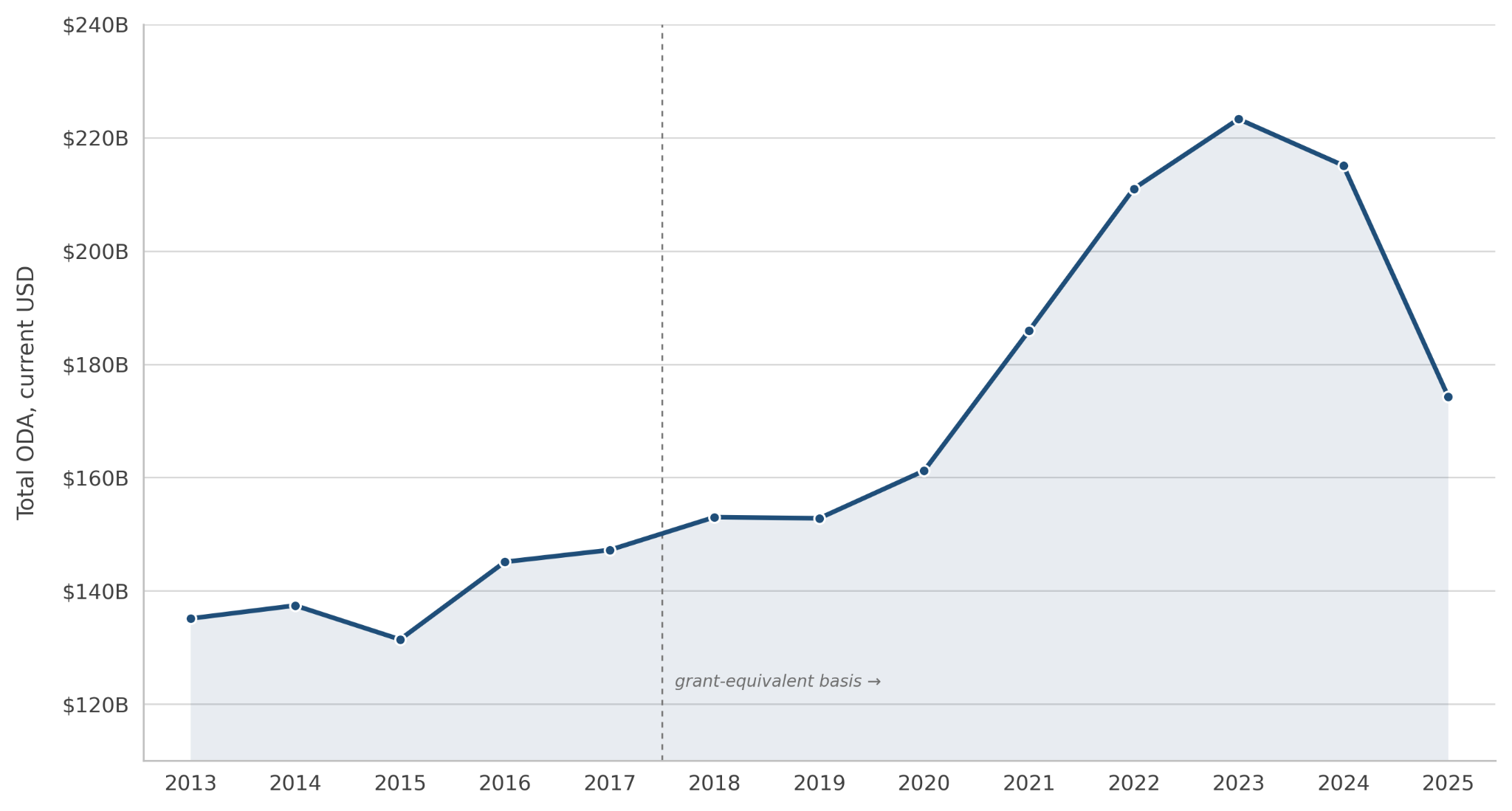
Figure 1. Total Official Development Assistance from OECD Development Assistance Committee members, 2013–2025 (current US$) (OECD, 2026a, Tables 1–2; OECD, 2026e, Table DAC1). Data for 2025 is preliminary.
26 of the 33 members of the Development Assistance Committee reduced their assistance in 2025, yet the five largest providers alone accounted for 95.7% of the total fall. The United States was responsible for 75.1% of the decline, as its own assistance dropped by 56.9%, the largest reduction any provider has recorded in any year. Germany, the United Kingdom, France and Japan cut theirs by 17.4%, 10.8%, 10.9% and 5.6% respectively, making 2025 the first year in which all five leading providers reduced their assistance at once. The result was a change at the top rather than a redistribution. Germany became the largest provider for the first time in the history of the Committee, at $29.1 billion, or 16.7% of the Committee total, but it did so while cutting its own budget, and its lead over the United States in second place amounted to $135 million. Only Denmark, Luxembourg, Norway and Sweden met the 0.7% commitment, and the G7 share of the total fell to 69.1%, its first reading below 70% since 2012 (OECD, 2026a).
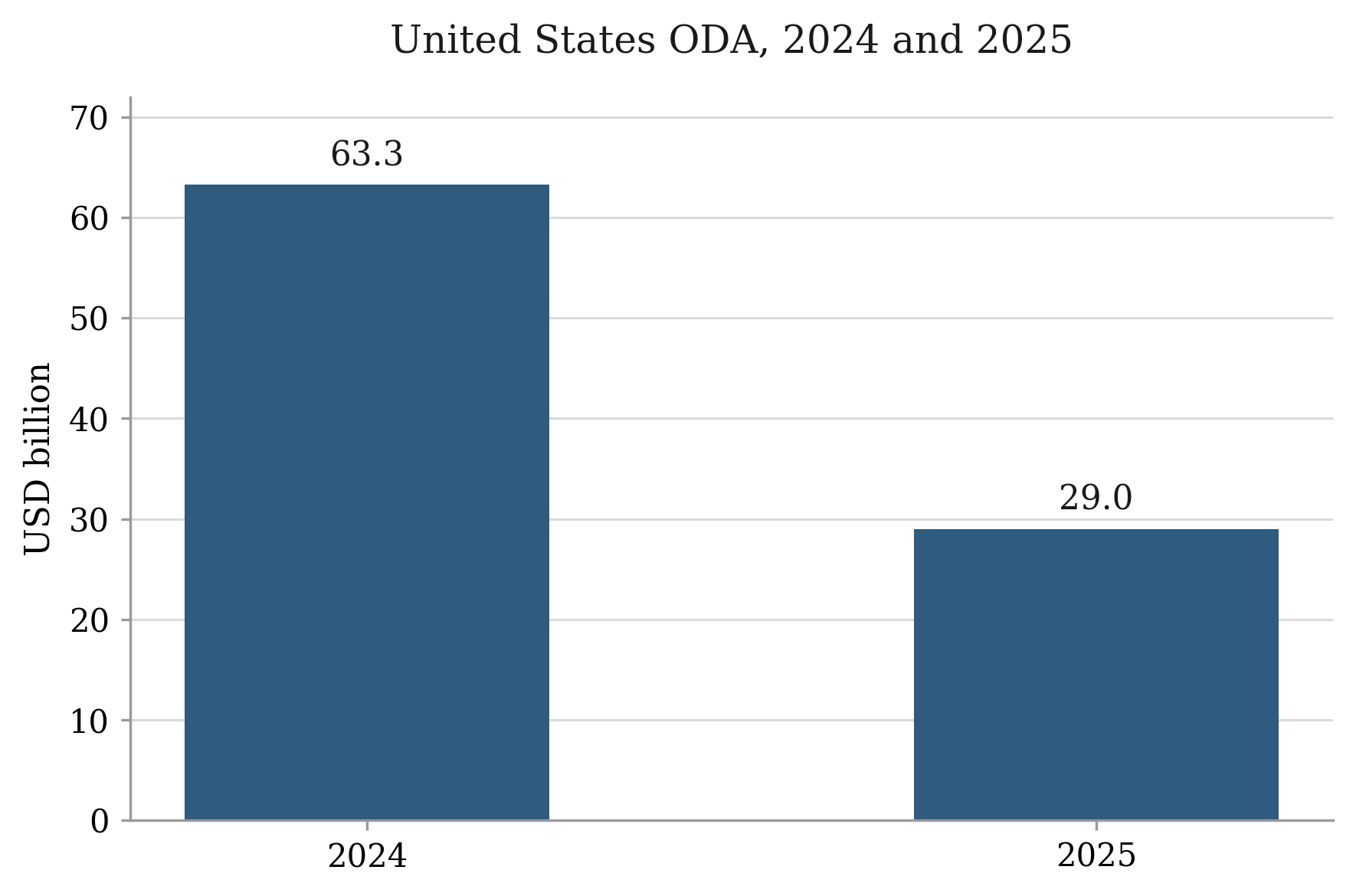
Figure 2. United States official development assistance, 2024 and 2025 (current US$) (OECD, 2026a, Table 1). Data for 2025 is preliminary.
The composition of what remained shifted as much as the volume. Bilateral assistance fell by 26.4% to $126.4 billion, and within it grants fell by 29.1% while sovereign loans fell by only 10.3%, so that lending held its position as grant-based transfers retreated. Instruments channelled through the private sector rose by 13.1%. Humanitarian assistance was cut by 35.8% to $15.5 billion, and spending on refugees inside donor countries fell to $23.0 billion, though this still absorbed 13.2% of all assistance, a share slightly higher than the year before. Funding for development programmes, projects and technical cooperation fell by 26.3%, the largest drop on record for a component that had grown by 24.2% between 2019 and 2023. That last figure matters most because it shows the cuts reached the stable core of development work rather than the volatile items that ordinarily absorb them (OECD, 2026a). Donor-level reporting shows the same pattern. Of the £12.8 billion the United Kingdom provided in 2022, the largest single component was £3.69 billion for refugee costs inside the United Kingdom, ahead of the £966 million spent on health (FCDO, 2024).
Multilateral assistance fell by 12.7% to $47.9 billion, a second consecutive annual decline that leaves it 21.3% below its 2023 level. The losses were not spread evenly across institutions. Core funding for the United Nations system fell by 27.0%, the steepest annual drop that channel has recorded, with an American cut of 87.2% as the primary driver, while core support to the World Bank rose by 6.4% and to the regional development banks by 11.9%. Money therefore moved away from the bodies in which recipient states hold formal voice and towards institutions organised around lending and creditor governance.
The allocation of what was left followed a similar logic. Counting outflows from the European Union institutions, Ukraine received $44.9 billion, the largest volume of assistance ever provided to a single recipient, exceeding the $28.1 billion received by all least developed countries and the $29.2 billion received by all of Sub-Saharan Africa, both of which fell by 25.8% and 26.3% respectively, showing how foreign aid is being directed to military and other non-developmental purposes (OECD, 2026a). These reductions are especially significant because development finance already falls well short of recipient countries’ investment needs. Africa alone needs an estimated $130 to $170 billion a year in infrastructure spending, but total spending from all sources reached only $100.8 billion in 2018, of which African governments provided $37.5 billion (Infrastructure Consortium for Africa, 2019). The gap is widest in water and sanitation, which requires $56 to $66 billion a year but received an average of just $13 billion (African Development Bank, 2019).
At the same time, donor budgets moved in the opposite direction on defence. NATO reporting shows the United Kingdom, France and Germany all increased military spending as a share of GDP between 2022 and 2026, by 16%, 50% and 84% respectively (NATO, 2026). Over roughly the same period, ODA as a share of gross national income fell in all three, by 33% in Germany, 25% in France and 16% in the United Kingdom (OECD, 2026b). Taken together, these trends suggest that many Western donors are increasingly prioritising defence and short-term geopolitical objectives over long-term development finance.
Providers outside the Committee that voluntarily report on comparable terms disbursed $17.99 billion in 2024 on a grant equivalent basis (OECD, 2025). That figure is the closest available official measure of non-Western assistance, yet it captures only a fraction of total flows. The remainder must be reconstructed from project-level data because the largest providers do not report their assistance. AidData’s most recent accounting records nearly $2.2 trillion of commitments across 33,580 projects and activities in 217 countries between 2000 and 2023, financed by 1,193 Chinese official sector institutions, of which around 2.11 trillion consisted of loan commitments (Parks et al., 2025). Within that total, 23,816 projects worth over $1.2 trillion went to 142 low- and middle-income countries, while roughly 10,000 projects and activities worth close to $1 trillion went to 72 high-income countries (Parks et al., 2025). These numbers superseded the earlier version of the dataset that covered only developing countries between 2000 and 2021, totalling 20,985 projects valued at $1.34 trillion in 165 countries (Custer et al., 2023). Any research conducted prior to 2025 uses the above-mentioned limited dataset.
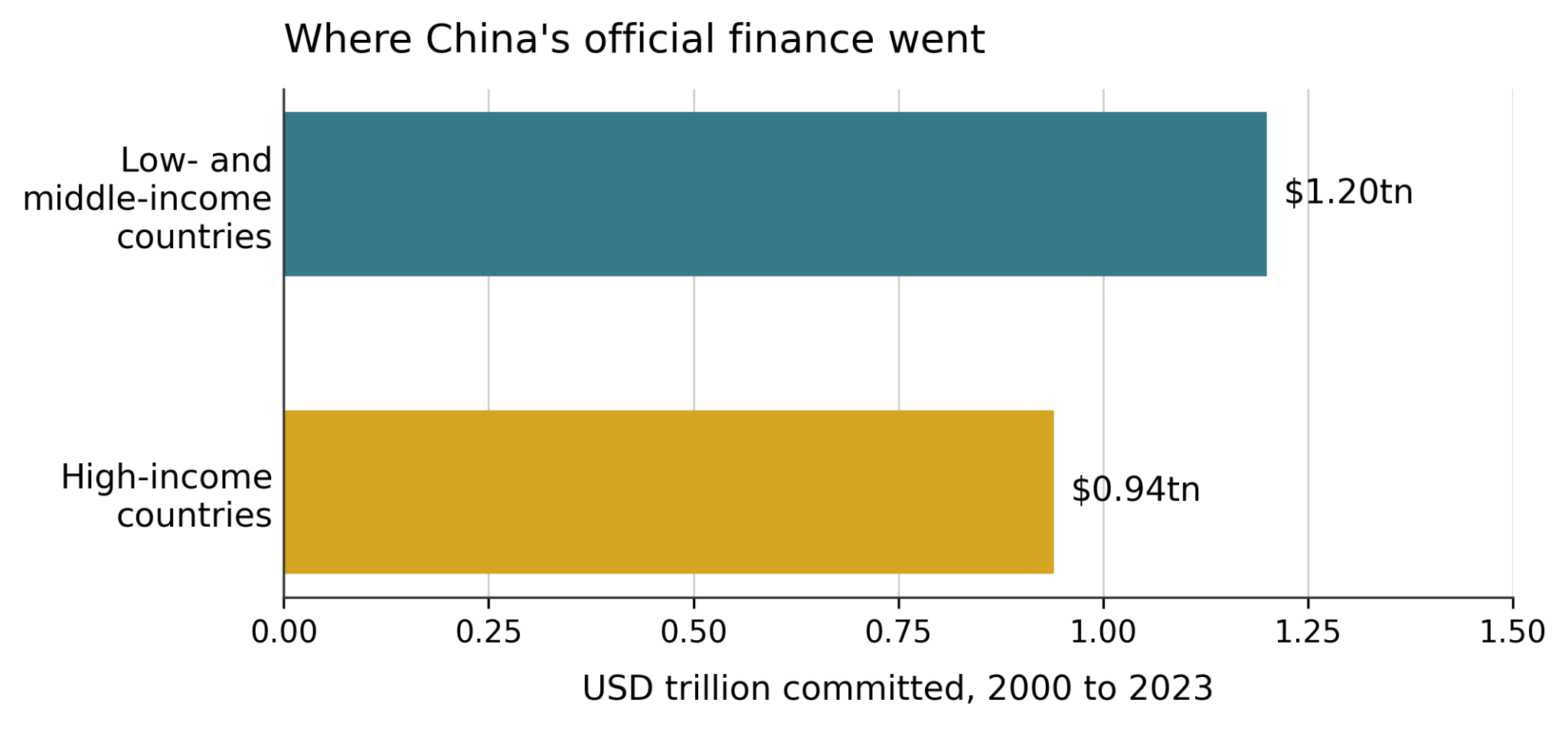
Figure 3. Chinese official finance commitments by recipient income group, 2000 to 2023 (Parks et al., 2025).
The developing world now owes China between $1.1 and $1.5 trillion; about 80% of the portfolio supports countries already in financial distress, and more than half of the loans have entered repayment, a share set to reach roughly three-quarters by 2030 (Parks et al., 2023). The share of the portfolio supporting upper-middle- and high-income countries rose from 11% in 2000 to 76% in 2023, while the share supporting low- and lower-middle-income countries fell from 88% to 24%. AidData’s global reconstruction of the portfolio shows that at its peak, infrastructure project lending absorbed three quarters of all lending, and it now absorbs under a quarter. The Belt and Road numbers show the same retreat from another angle: infrastructure commitments in participant countries totalled $249 billion between 2014 and 2023, a fifth of everything China lent abroad across that decade (Parks et al., 2025).
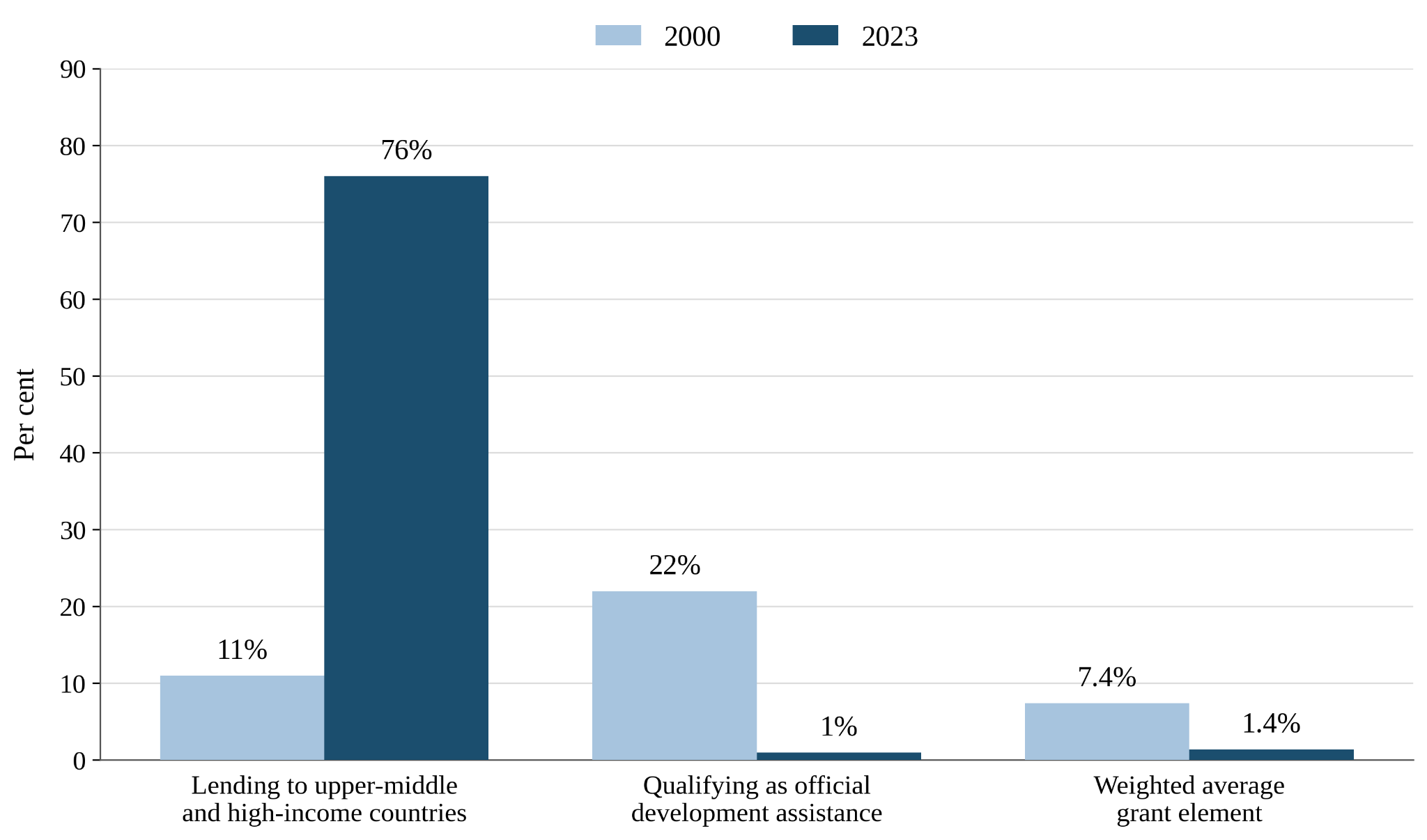
Figure 4. Composition of China’s overseas lending and grant-giving portfolio, 2000 and 2023 (Parks et al., 2025, Figures 1.1–1.3). The grant element is a concessionality measure running from 0% to 100%; the other two series are portfolio shares.
The share of China’s overseas lending and grant-giving portfolio that qualifies as official development assistance fell from 22% in 2000 to 1% in 2023, and the weighted average grant element of its lending portfolio fell from 7.4% to 1.4% over the same period (Parks et al., 2025). Its assistance budget in a typical year is around $5.7 billion – roughly the level of a donor such as Italy – and in 2023 its global assistance commitments fell to $1.9 billion, the lowest level in two decades (Parks et al., 2025). Chinese cross-border loans also carry higher interest rates and shorter repayment periods than those of other official creditors (Parks et al., 2025). In terms of lending conditions, Horn et al. (2021) found that the conditions attached to Chinese state-directed international loans typically resemble commercial rather than official lending, and that China had become the world’s largest official creditor by 2017, surpassing both the World Bank and the International Monetary Fund (IMF).
Belt and Road activity has also been measured on a second basis. That accounting records $1.399 trillion of Chinese engagement in participant countries since 2013, of which $837 billion took the form of construction contracts and $561 billion non-financial investment, across more than 145 countries that have signed cooperation agreements (Nedopil Wang, 2026; Green Finance and Development Center, 2026). The two totals are not alternatives. AidData counts official-sector lending commitments, while this measure counts contracted construction and investment activity irrespective of financing source.
Gulf assistance from Kuwait, Saudi Arabia and the UAE is substantial but follows religious and political affiliation rather than governance or reform criteria (Neumayer, 2003; Villanger, 2007). Indian assistance is smaller and export-led, with the Export-Import Bank of India often financing projects China had financed the year before, showing competition-driven financing (Asmus-Bluhm et al., 2025). Both receive no further analysis, since Gulf reporting is intermittent and Indian-tied credits carry no concessionality data. Comparison with DAC Official Development Assistance therefore rests primarily on China, examined above, and on Türkiye, to which the discussion now turns.
Türkiye, which reports voluntarily to the Committee, differs fundamentally from China. In 2025, Türkiye provided a preliminary $7.5 billion in ODA (0.5% of GNI), a 9% real decline from 2024, leaving it below the international 0.7% ODA/GNI target (OECD, 2026d). The latest available OECD data shows that 98.7% of Türkiye’s ODA was provided bilaterally in 2024, with only 1.3% channelled as core contributions to multilateral organisations (OECD, 2026d). Turkish aid is also overwhelmingly humanitarian rather than developmental. Humanitarian aid amounted to $6.1 billion, or 83.1% of gross bilateral assistance; in-donor refugee costs amounted to $486.9 million, or 6.7%; and country programmable aid, the portion around which recipient governments can plan, amounted to $458 million, or 6.3% (OECD, 2026d). Emergency response absorbed almost all humanitarian assistance, while reconstruction, relief and rehabilitation received just $18.8 million and disaster prevention and preparedness $0.6 million. Social infrastructure and services accounted for 525.2 million, or 7.2% of bilateral assistance (OECD, 2026d).
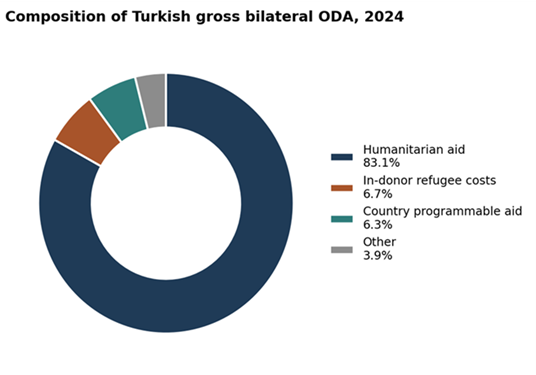
Figure 5. Composition of Turkish gross bilateral ODA, 2024 (OECD, 2026d).
The Middle East alone absorbs 84.9% of gross bilateral assistance in 2024 against 1.9% for Africa, and the top ten recipients, led by Syria, account for 85.6% of the total. The list of Türkiye’s top bilateral ODA recipients in 2024 further reflects this pattern. The ten largest recipients were the Syrian Arab Republic, the West Bank and Gaza Strip, and Somalia, followed by Azerbaijan, Kazakhstan, Senegal, Niger, Pakistan, Sudan and Afghanistan (OECD, 2026d).
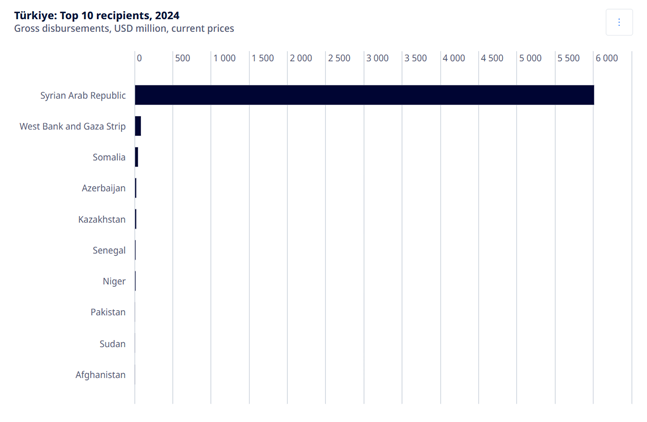
Figure 6: Türkiye’s gross ODA disbursements by recipient country, 2024 (OECD, 2026d).
Turkish assistance is therefore large in volume, narrow in geography and almost entirely humanitarian in composition, which distinguishes it from the DAC pattern in allocation and from the Chinese one in instrument.
4. Discussion
Five problems in the data deserve a statement before any discussion is presented. The two categories are not versions of the same measure, since ODA is legally defined and carries a concessionality criterion that most Chinese official finance would not meet, as demonstrated by the fall in the weighted average grant element in Section 3. AidData also records commitments, and because projects are cancelled, delayed or rescoped, data can often overstate what was delivered. Both sides are underreported as well. Horn et al. (2021) found that roughly half of Chinese official lending is missing from IMF and World Bank debt statistics, while Gulf providers report to the OECD only intermittently (Neumayer, 2003; Villanger, 2007). Moreover, Chinese assistance is assessed two years following the initiation of projects, whereas Western assistance is evaluated over four-year and sometimes multi-decade horizons. Consequently, their findings are not directly comparable (Clemens et al., 2012; Dreher et al., 2022). Finally, the recent OECD aggregates that were calculated are preliminary and subject to revision as they get more precise information.
4.1 Economic Growth: The Chinese Approach
Chinese investment uses a different approach to typical Western foreign aid, prioritising large-scale investment, mainly in infrastructure. This raises the question of whether China’s way of giving aid is more effective at generating economic growth than the Western approach, which focuses on improving governance and institutions. The Chinese portfolio described above is concentrated in transport, energy and industry, sectors in which recipient capacity was often weak before the projects began. Custer et al. (2023) argue that these projects give developing countries another option for economic growth by improving infrastructure that may previously have been substandard – for example, limited energy access, which has historically slowed growth.
Bräutigam (2009) develops this argument in The Dragon’s Gift, contending that China’s support for developing countries is more varied than traditional foreign aid because it includes different forms of economic support – loans, investment and trade partnerships – that support economic growth. She argues that African countries prefer Chinese finance because it provides roads, railways and power stations that promote economic growth by lowering transportation expenses and production. The scale of that commitment is set out in Section 3, and its recent direction matters for her argument. Bräutigam’s case rests on China offering a broader menu than traditional donors, combining loans, investment and trade. The contraction of transport finance and the shift toward construction contracting suggest the menu is narrowing toward a single item, delivered on increasingly commercial terms.
A key example of China supporting economic growth is the Addis Ababa-Djibouti Railway, which connects Ethiopia to the Port of Djibouti, through which around 90% of its trade passes (Global Infrastructure Hub, 2020). Before the railway, almost all corridor cargo moved by road, raising transport costs and hindering export-oriented industrialisation (Global Infrastructure Hub, 2020). In the short term, the $4.5 billion investment (South China Morning Post, 2024) in construction created job opportunities for approximately 2,000 people, trained over 300 workers in railways and reduced long-haul freight journeys from about 50 hours to about ten hours (Global Infrastructure Hub, 2020). In the intermediate term, low freight rates compared to roads assisted the Ethiopian manufacturers (Global Infrastructure Hub, 2020). Rail’s share of national trade freight rose from 8.5% in 2018 to about 15% by 2024 (Capital Ethiopia, 2024). This supports Bräutigam’s argument that Chinese infrastructure can help African businesses grow, though she adds that firms must be competitive enough to benefit (Bräutigam, 2009). However, the success of this project in the long run appears doubtful. Income amounted to just $40 million in 2019 against a target of $150 million (AllAfrica, 2020), and costs stayed higher than income until the operator’s first profitable quarter at the end of 2024 (Ethiopian Monitor, 2025). Traffic never reached the levels the forecasts assumed, Ethiopia defaulted on its repayments more than once and the Chinese state insurer Sinosure has since covered China Eximbank’s losses with at least eight payouts worth around $200 million (AidData, n.d.). Chinese lenders also had to reschedule the debt from 15 to 30 years (Global Infrastructure Hub, 2020). This illustrates a broader weakness of the Chinese investment approach: projects support economic growth only if they generate enough returns to justify their cost.
Chinese finance also faces several persistent criticisms. The best known is the “debt-trap diplomacy” theory created by Chellaney according to which China makes generous loans to nations which are prone to have difficulties in servicing their debts, thus increasing its influence; moreover, the costs connected with servicing such a loan negatively affect the country’s development because they do not allow the government to spend money on useful investments (Chellaney, 2017). This approach is disputed by Jones and Hameiri who believe that this theory ignores some details: for example, in Sri Lanka and Malaysia, the most disputed Chinese projects were started by the governments of those countries and the problem of debt arose mostly due to the corruption of elites in those countries and loans in Western-oriented financial markets and not due to the strategy of China (Jones & Hameiri, 2020). Hence, scholars remain uncertain about whether the intentions of the donor or recipient’s failures are responsible for those projects. Chinese projects are also harder to evaluate than Western ones, since the Western system is largely multilateral and carries an established practice of impact evaluation, while Chinese finance is delivered bilaterally through state banks and companies with almost no public evaluation (Bräutigam, 2011; Custer et al., 2023). In a study of 100 contracts, borrowers were often forbidden from telling anyone the loan existed, Chinese lenders could seize the accounts where borrowers were paid and they could demand all the money back early for many different reasons (Gelpern et al., 2021). In addition, China does not pursue humanitarian goals through its aid but rather its own economic goals, such as access to resources and good relations globally. However, those projects can be beneficial for the recipient countries too as they develop the infrastructure and the economy.
China’s Belt and Road Initiative (BRI) also works as an instrument of global influence. Built around infrastructure development, trade, financial integration and policy coordination, it now reaches the majority of the world’s states (Green Finance & Development Center, 2026). Djibouti is the clearest case, since China developed the Doraleh port and opened its first African military base minutes away (Africa Defense Forum, 2026), securing the maritime route around the Horn of Africa (Library of Congress, 2021). In Kenya, the Mombasa-Nairobi railway serves a similar purpose, linking the country’s largest port to its capital under Chinese finance. Western donors have instead stressed governance, institutions and public services. UK aid, for instance, has focused on health, humanitarian support and governance rather than major infrastructure. However, as Section 3 shows, domestic refugee-hosting costs exceeded health spending, which limits how much of it reached the institutional objectives the approach is built around. The case for this approach rests on evidence that better governance raises incomes, while growth alone does not reliably improve governance (Kaufmann & Kraay, 2002). The record of that approach is mixed rather than poor. Western assistance has produced measurable welfare gains, including the eradication of smallpox and sustained improvements in child survival, even as it has attracted persistent criticism for its weak effect on economic growth (Easterly, 2006). China’s infrastructure-first approach can generate faster, more visible economic growth – railways and roads immediately ease the movement of goods – whereas aid directed at institutions and governance tends to take longer to produce results, since its aim is to strengthen the underlying conditions for long-term growth.
In summary, non-Western aid, and China’s approach in particular, has played an important role in supporting economic growth in developing countries by raising economic activity and production where poor infrastructure has historically limited growth. The Addis Ababa-Djibouti Railway demonstrates how Chinese-funded projects can improve trade opportunities, though high costs, maintenance and management difficulties, and uneven demand show that infrastructure investment alone does not guarantee long-term success. The effectiveness of Chinese aid remains debated: concerns about debt sustainability, limited transparency and China’s own economic interests suggest its aid is not purely altruistic, though the “debt trap” characterisation is contested, since many countries actively choose Chinese investment and benefit from the resulting infrastructure. Chinese aid is most effective when projects are well planned, properly managed and supported by policies encouraging long-term growth; it should be viewed as neither wholly positive nor wholly negative, but as a model whose faster short-term benefits carry uncertain long-term payoffs.
4.2 Association: The Turkish Approach
The history of modern Turkish foreign aid originated on 5th June 1985, but expanded significantly after the establishment of the Turkish Cooperation and Coordination Agency (TİKA) in 1992. Aid then grew rapidly from $67 million in 2003 to $2.53 billion in 2012, making Türkiye an important rising donor country outside the West (Turhan, 2021). TİKA currently operates in about 170 aid-receiving states (Beşgül, 2024).
Turkish aid’s greatest limitation is that it is heavily influenced by identity and geography rather than need. In 2024, Türkiye allocated just 0.01% of its GNI to the least developed countries (OECD, 2026d), while Turkic republics and majority-Muslim states receive disproportionately large funding compared with non-Muslim recipients (Zengin & Korkmaz, 2019). Between 2010 and 2016, former Ottoman states received $4.64 billion in Turkish aid in total, more than double the $2.15 billion going to states with no Ottoman past. Religion mattered just as much: Muslim-majority countries received $6.12 billion over the same period, against $392 million for countries less than half Muslim and $189 million for those under 5%. Turkic republics received the most, at $6.75 billion (Zengin & Korkmaz, 2019).
The country-level pattern shown in Figure 6 follows the same logic. The countries at the top of that list have little in common in terms of income or measured need. Syria and the West Bank are genuine emergencies, but Azerbaijan and Kazakhstan are upper-middle-income states with no humanitarian crisis, and their presence alongside so small an allocation to least developed countries indicates a selection based on affinity rather than poverty.
Moreover, the composition of that assistance limits what it can achieve once the emergency passes. Because emergency response absorbs the overwhelming share of bilateral assistance and the programmable portion is very small, as Figure 5 shows, recipient governments cannot plan around Turkish aid even where they receive a great deal of it. The result is a great deal of visible relief and very little of the long-term institutional support on which development outcomes depend.
Apart from delivering humanitarian aid, Türkiye also employs aid as an approach to exert soft power. Türkiye engages in funding cultural and educational projects such as the restoration of mosques, naming schools after Atatürk and building genocide memorials that serve as means of cementing common historical ties and creating lasting political leverage rather than development per se (Beşgül, 2024). The case of Somalia can be considered a perfect example of this strategy. A decade of involvement made Somalia Türkiye’s window into Sub-Saharan Africa and enhanced its image as a middle power willing to intervene where others failed to do so (Dahir & Cismaan, 2021). Moreover, during the COVID-19 pandemic, Türkiye delivered masks and hygiene kits to almost six million people in 77 different states (Beşgül, 2024). Also, aid is inseparably connected to commercial considerations: 1% increase in Turkish exports to a state is followed by 0.251% growth in aid (Zengin & Korkmaz, 2019).
The traditional donors of the OECD Development Assistance Committee resemble Türkiye in some ways and differ sharply in others, since both rely mainly on grants rather than loans. Beyond that they diverge sharply, and the Turkish model distinguishes itself in three main aspects. The first is scale, considering that the volume of assistance provided through DAC dwarfs the assistance by Türkiye despite the decline mentioned in Section 3. The second is conditionality, as Türkiye has generally avoided attaching political conditions to its aid, which places it closer to the emerging donors and the South-South model (Stearns & Sucuoğlu, 2017). The third is allocation, as Türkiye allocates aid based on common identities instead of need, favouring former Ottoman states, Muslim majority countries and Turkic republics.
Taken together, Türkiye’s aid model is thus best understood as a strong short-term humanitarian provider with limited political conditionality. At the same time, its long-term impact appears less certain, with aid allocation influenced more by shared identity and strategic interests rather than recipient’s need.
4.3 Infrastructure Development
This section focuses on sustainable infrastructure, meaning projects that remain economically, socially and environmentally viable across their full life cycle (Inter-American Development Bank, 2018). Sustainable infrastructure is closely tied to a country’s GDP and standard of living (Müller & Ahmed, 2024), serving as a foundation for social overhead capital, wider public access to resources and greater income for citizens (Ofori et al., 2024). Yet countries that need infrastructure run persistent deficits, as demonstrated in Section 3. Outside parties fill this gap through OECD countries’ Official Development Assistance and China’s Belt and Road Initiative, which spans over 150 countries and largely excludes major OECD countries (McBride et al., 2023). The BRI therefore stands here for non-Western infrastructure finance without standing for non-Western aid as a whole.
Both Western and non-Western states finance infrastructure development using different tools. Grants have been the main form of Western assistance, whereas China finances its aid mostly through loans. Around half of China’s assistance budget is allocated to concessional loans for infrastructure projects aligned with the BRI’s emphasis on hard infrastructure (Sun, 2025), and the lending share of the wider portfolio is set out in Section 3. This distinction carries directly into debt outcomes. Western grants do not require repayment, while BRI loans are close to market rates and are rarely forgiven; historical data on renegotiated Chinese debt show China does not typically write off debt but instead pushes repayment later (McBride et al., 2023). The consequences have been severe in several recipient countries. In Pakistan, imports required for China-Pakistan Economic Corridor infrastructure widened the budget deficit and ultimately required an IMF bailout. Debt to China now exceeds 20% of GDP in some countries, and in Ghana and Zambia, sovereign default has devastated national economies – prominent examples of what critics term debt-trap diplomacy, in which a stronger creditor extends loans a borrower cannot realistically repay. At the same time, sovereign default may be a calculated risk some nations accept: as OECD foreign aid has declined, many developing nations have fewer alternative options for financing infrastructure (McBride et al., 2023). OECD donors thus provide more in grants, but the BRI has grown more attractive as Western funding has contracted.
Financing infrastructure through either channel can create dependency, measured in this paper by calculating the ratio of annual infrastructure finance to the GDP. Among Western recipients, lower-income countries tend to rely more heavily on OECD infrastructure aid. The difference between Bangladesh and Argentina demonstrates this pattern. Between the years 2020 and 2024, the country had a GDP of $427.6 billion and received on average $1.798 billion from the OECD as infrastructure support per year (0.42% of GDP). On the other hand, Argentina had an annual GDP of $556.9 billion and received $10.48 million per year from the OECD (0.002% of GDP) (World Bank, 2026a, 2026b, 2026c; OECD, 2026c). This indicates that the dependency of Bangladesh on such grants was 224 times greater than that of Argentina. While it should be noted that the GDP figures for Argentina are influenced by high inflation and exchange rate fluctuations, the comparison is rather indicative than conclusive. China’s loans, by contrast, create a different kind of dependency: because the money must be repaid, it is less likely to be simply consumed and more likely to be directed toward productive uses that generate further revenue for both donor and borrower, though the same repayment obligation can also push poorer countries toward the debt and default problems described above. Grants therefore risk dependency through the depletion of external finance, while loans risk dependency through debt, even as they encourage more productive use of the funds received.
Both systems also fulfil the interests of the donor nations in a broader sense, although through different channels. The West’s infrastructure development aid is typically aimed at developing sectors such as transportation that facilitate trade; the OECD Aid for Trade programme aims to foster economic development in poor and middle-income nations by creating good roadways, railways, ports and communication networks connecting their economies to international markets. The BRI, by contrast, more often secures resources and leverage through loan collateral and contract terms. The most famous case is the 99-year lease of Sri Lanka’s Hambantota Port, which helped popularise the term “debt-trap diplomacy”, though Bräutigam argues Sri Lanka chose to sell the stake itself to raise foreign currency for debt owed to other creditors (Bräutigam, 2020). Many BRI loan contracts also require borrowing nations to employ workers from the creditor nation, channelling some financing back into China’s own economy, and studies of BRI contracts find clauses restricting recipients’ ability to restructure debt with the Paris Club of Western creditor nations, alongside China’s standing right to demand repayment on short notice – leverage that can be used to advance political goals such as requiring a nation to sever ties with Taiwan (McBride et al., 2023). Western countries, by comparison, exert influence more subtly: OECD policy recommendations urging transparency and long-term planning become de facto global standards for what constitutes “proper” infrastructure, and the fact that grants require no repayment allows Western donors to build influence through appeal rather than compulsion, though this soft-power appeal is now complicated by the recent decline in Western aid volumes (OECD, 2020).
Overall, OECD aid organisations and BRI lenders represent different approaches to infrastructure financing, yet both fall short in fully solving the issue of finance gaps for infrastructure development; the former is relatively less risky but subject to the vagaries of donor reduction, whereas the latter increases infrastructure development capacities yet poses bigger risks and complexities on the repayment side. The continuation of infrastructure development in low- and middle-income countries would thus mean that Western donors, and particularly the US, must increase their grants, and BRI lenders must enhance debt relief and streamline loan agreements, including politically motivated clauses.
4.4 Militarisation and the Consistency of Aid
A further point of comparison is the consistency of aid flows, since recipient countries generally prefer economically stable donor partners; foreign aid delivered inconsistently appears less effective and less productive. War, crises and armed conflict are among the clearest destabilising forces, since a conflict with global consequences – shifts in the price of natural resources, higher inflation, humanitarian and economic crises – can lead some donor countries to reduce or rearrange their foreign aid commitments.
As a consequence of the prolonged conflict between Russia and Ukraine, together with recent shifts in United States foreign and defence policy, major European NATO members have faced pressure to raise military spending during a period of heightened security threats. According to Section 3, Germany, France and the United Kingdom all increased their military expenditures relative to their GDP in the period 2022 to 2026 and reduced their ODA as percentage of GNI in the same period. Both actions have similar magnitudes and occur in an opposite direction. This is the type of trend that is taken to indicate rearmament as a replacement of development aid. The United Kingdom in particular appears set to become a less reliable aid partner: its Independent Commission for Aid Impact projects that UK foreign aid will fall by up to 42% – some £6.5 billion – by 2028, with aid to long-standing partners such as Tanzania, Kenya and Rwanda cut by as much as 90% as resources are redirected toward other priorities (Palmer, 2026).
United States foreign aid, by contrast, appears more consistent on its face, having exceeded $50 billion annually since at least 2004 despite hundreds of billions in simultaneous military spending – the largest volume of foreign assistance from any single donor in the world (ForeignAssistance.gov, n.d.). Closer examination, however, reveals that this assistance correlates closely with US foreign policy interests: countries that were partially or fully subject to US military or economic intervention tend to receive substantially more foreign assistance, both military and economic, than others. During US interventions in Vietnam, Yemen, Afghanistan, Iraq, Somalia, Libya and Yugoslavia, US foreign assistance to those countries rose sharply, typically peaking during the intervention itself (ForeignAssistance.gov, n.d.). This pattern suggests that US aid may be driven as much by strategic and political interest as by humanitarian concern, and that financial and humanitarian assistance in these regions may function partly to legitimate US intervention itself.
Non-Western donors are harder to assess on this dimension, since most emerged too recently for two decades of consistent data to fully capture their patterns; the discussion here focuses on China. China’s assistance differs structurally from that of DAC states in the ways described above, and the feature that matters for consistency is not its instrument but its doctrine. China’s policy of non-interference in recipient countries’ internal affairs – decoupling its assistance from human-rights conditions and political instability – appears to grant its foreign aid a relatively high degree of operational consistency, even as it raises separate concerns about the governance conditions under which that aid is delivered (OCHA, n.d.; Seppänen & Smith, 2025).
Taken together, these patterns suggest that Western and non-Western donors face different threats to the consistency of their aid. Western consistency is vulnerable to shifting domestic political and security priorities: European militarisation in response to the war in Ukraine has already forced real cuts to ODA budgets, and planned reductions in the United Kingdom suggest further volatility is likely through the rest of the decade. United States aid, while large and outwardly stable in volume, is tied closely to the country’s own military and strategic interests, so its consistency reflects continuity of foreign policy rather than a stable commitment to development for its own sake. China’s non-interference doctrine, by contrast, appears to buy a form of consistency that is largely insulated from both recipient-country politics and China’s own domestic security spending, though this comes at a cost, since the same doctrine that stabilises Chinese aid also limits independent evaluation of how it is used. On this measure, non-Western aid, more specifically Chinese non-Western aid may currently offer developing countries a politically steadier partnership than either the European or American models, even as its lending terms carry the debt and dependency risks discussed earlier in this paper.
4.5 Main Takeaways
The conclusions that follow address both the responsibilities of particular stakeholders and the broader ways in which this subject should be studied and understood.
Recipient governments that receive both types of assistance should sequence them rather than choose between them. The evidence supports a simple rule: use grants to fund non-income generating projects, including health care systems, education, statistics, court systems and tax systems, while loans should be used to fund projects that can cover their costs through generated incomes. A hospital financed by a commercial loan and a toll road financed by a grant are both expensive mistakes. A second conclusion is that the coexistence of competing financing models benefits recipient governments by preserving bargaining power. With access to alternative providers, recipient governments can negotiate more favourable terms by exploiting competition among donors and lenders (Woods, 2008). That advantage disappears when one of the providers leaves the race. If a country reacts to the fall in Western grants in 2025 by switching from grant financing to loan financing, then this does not resolve the problem but compounds it.
For Western countries, outcomes will be shaped by what donors fund. A budget focused largely on refugees and crisis aid will continue producing little effect on growth. For stronger growth outcomes, donors will need to put more funding into development rather than humanitarian aid, but still protect humanitarian aid. Also, speed, one of the main complaints made against Western donors, is a policy decision and not something inherent in a country’s nature. AidData reports that G7 nations and multilateral institutions have made use of this strategy by reducing their approval process time due to competition from China (Parks et al., 2025).
Chinese and other Southern lenders should prioritise transparency, which is more important than borrowing even larger sums of money. Roughly half of Chinese official lending is absent from international debt statistics, and borrowers are frequently barred from disclosing that loans exist at all (Horn et al., 2021; Gelpern et al., 2021). Because published debt ratios therefore understate what a country owes, other creditors price risk and assess sustainability on incomplete information, and restructuring becomes harder once trouble arrives because no creditor can see the full claim structure. Secrecy raises the cost of borrowing, complicates restructuring and generates political blowback.
It is not poverty but affinity which decides the distribution pattern on both ends. Türkiye allocates 84.9% of its bilateral aid to the Middle East and just 0.01% of GNI to least developed countries. This is often read as a feature of emerging donors until Ukraine’s $44.9 billion in 2025 is compared with the sums reaching all least developed countries and Sub-Saharan African countries. Donors on both sides present themselves as responding to need while allocating by affinity, and closing that gap is a matter for donors rather than for the countries their criteria exclude.
It is impossible to make a direct comparison between the two models, and the literature should stop treating them as though they could. Western assistance does not require repayment whereas Chinese finance does, so the comparison sets a grant against a loan and asks which is more generous. The evidence is unequal as well, since roughly half of Chinese official lending is missing from international debt statistics. The proper approach is to examine which tool is suited to which task.
The last takeaway to draw is how aid is evaluated, which is not intended for a particular stakeholder. As estimated by Cavalcanti et al. (2025), USAID programmes managed to lower all-cause mortality by 15%, thereby avoiding an estimated 91 million deaths in the period from 2001 through 2021, and budget cuts of 2025 could lead to more than 14 million additional deaths by 2030. For donors contemplating cutting their budgets even further, such figures should be taken into account. Aid should be judged not only by its effect on growth, but also by its impact on human lives.
5. Conclusion
This paper compared Western and non-Western foreign aid on consistent measures, and it was observed that there is a difference in the margins on which both of them operate instead of competition. Western foreign aid is based upon grant-based, multilateral aid and it has produced welfare gains while showing little reliable effect on growth. Non-Western assistance, examined here through China and Türkiye, does not hold together as a single category, since China lends for infrastructure at a scale grants do not reach while Türkiye gives grants as DAC members do and departs from them in allocation rather than in instrument. A problem shared by both aid programmes is their tendency to allocate aid disproportionately toward countries with shared identities. Infrastructure finance differs most sharply, as Chinese lending carries mixed consequences for debt, whereas grant financing carries its own risk of dependency. As for consistency, Western assistance is more likely to be at risk, given the militarisation and shifting priorities of donor governments.
In future research, one could total every non-OECD country’s foreign aid rather than generalising from Chinese efforts alone, which would mean reconstructing Gulf and Indian flows from recipient-side sources such as budget documents, contract registries and debt records, much as AidData did for Chinese lending. A second asymmetry is harder to remove, since Chinese finance is delivered bilaterally with almost no public evaluation of the projects it funds, while Western assistance carries an established practice of impact assessment. That imbalance could be narrowed by combining Chinese and Western finance projects in the same country, industry and time period. In particular, it is important to consider the BRI, since it accounts for a substantial share of Chinese overseas lending. Whether non-Western lenders advance into the space Western donors have abandoned can be tested once data for 2026 and 2027 become available. Until then, the two models are best understood as operating on different margins, and the evidence assembled here supports no ranking between them.
Bibliography
Africa Defense Forum (2026) ‘China Seeks to Expand Influence Through Port Development’, Africa Defense Forum [online]. <https://adf-magazine.com/2026/03/china-seeks-to-expand-influence-through-port-development/>
African Development Bank (2019) ‘Africa’s Infrastructure Financing Reaches an All-Time High in 2018, Surpassing $100 Billion’, African Development Bank [online]. <https://www.afdb.org/en/news-and-events/press-releases/africas-infrastructure-financing-reaches-all-time-high-2018-surpassing-100-billion-ica-32728>
AidData (n.d.) ‘China Eximbank Provides $220 Million Buyer’s Credit Loan for Addis Ababa–Djibouti Railway Rolling Stock Supply Project’, Global Chinese Development Finance Dataset, Project ID 70083, (Williamsburg, VA: AidData at William and Mary).
AllAfrica (2020) ‘Ethiopia-Djibouti Railway Vows to Reverse Losses’, AllAfrica [online]. <https://allafrica.com/view/group/main/main/id/00074971.html>
Arndt, C., Jones, S., and Tarp, F. (2015) ‘Assessing Foreign Aid’s Long-Run Contribution to Growth and Development’, World Development, 69, 6–18.
Asmus-Bluhm, G., Eichenauer, V. Z., Fuchs, A., and Parks, B. (2025) ‘Does India Use Development Finance to Compete With China? A Subnational Analysis’, Journal of Conflict Resolution, 69(2–3), 406–33.
Banerjee, A.V. and Duflo, E. (2011) Poor Economics: A Radical Rethinking of the Way to Fight Global Poverty (New York: PublicAffairs).
Beşgül, B. (2024) ‘The Evolution of TİKA: A Case Study in Turkish Soft Power Projection’, Liberal Düşünce Dergisi, 115, 57–82.
Bluhm, R., Dreher, A., Fuchs, A., Parks, B.C., Strange, A.M. and Tierney, M.J. (2025) ‘Connective financing: Chinese infrastructure projects and the diffusion of economic activity in developing countries’, Journal of Urban Economics, 145, 103730.
Boone, P. (1996) ‘Politics and the Effectiveness of Foreign Aid’, European Economic Review, 40(2), 289–329.
Bräutigam, D. (2009) The Dragon’s Gift: The Real Story of China in Africa (Oxford: Oxford University Press).
Bräutigam, D. (2011) ‘Aid “With Chinese Characteristics”: Chinese Foreign Aid and Development Finance Meet the OECD-DAC Aid Regime’, Journal of International Development, 23(5), 752–64.
Bräutigam, D. (2020) ‘A Critical Look at Chinese “Debt-Trap Diplomacy”: The Rise of a Meme’, Area Development and Policy, 5(1), 1–14.
Burnside, C., and Dollar, D. (2000) ‘Aid, Policies, and Growth’, American Economic Review, 90(4), 847–68.
Capital Ethiopia (2024) ‘Ethio Djibouti Railway Aims for 4.5 Billion Birr Revenue’, Capital Newspaper [online]. <https://capitalethiopia.com/2024/03/18/ethio-djibouti-railway-aims-for-4-5-billion-birr-revenue/>
Cavalcanti, D.M., McGuire, C., Arsenault, C., Glassman, A., Bump, J.B., Gonsalves, G., Atun, R. and Yamey, G. (2025) ‘Evaluating the Impact of Two Decades of USAID Interventions and Projecting the Effects of Defunding on Mortality up to 2030: A Retrospective Impact Evaluation and Forecasting Analysis’, The Lancet, 406(10412), 565–77.
Chellaney, B. (2017) ‘China’s Debt-Trap Diplomacy’, Project Syndicate [online]. <https://www.project-syndicate.org/commentary/china-one-belt-one-road-loans-debt-by-brahma-chellaney-2017-01>
Clark, N. (2023) ‘The Rise and Fall of the BRI’, Council on Foreign Relations [online]. <https://www.cfr.org/articles/rise-and-fall-bri>
Clemens, M. A., Radelet, S., Bhavnani, R. R., and Bazzi, S. (2012) ‘Counting Chickens when they Hatch: Timing and the Effects of Aid on Growth’, The Economic Journal, 122(561), 590–617.
Custer, S., Dreher, A., Elston, T. B., Escobar, B., Fedorochko, R., Fuchs, A., Ghose, S., Lin, J., Malik, A., Parks, B. C., Solomon, K., Strange, A., Tierney, M. J., Vlasto, L., Walsh, K., Wang, F., Zaleski, L., and Zhang, S. (2023) Tracking Chinese Development Finance: An Application of AidData’s TUFF 3.0 Methodology (Williamsburg, VA: AidData at William and Mary).
Dahir, A. H., and Cismaan, S. (2021) ‘Turkey in Africa: A Decade of Turkish Aid and State-Building in Somalia’, TRT World Research Centre [online]. <https://researchcentre.trtworld.com/publications/policy-outlook/turkey-in-africa-a-decade-of-turkish-aid-and-state-building-in-somalia/>
Dreher, A., and Fuchs, A. (2015) ‘Rogue Aid? An Empirical Analysis of China’s Aid Allocation’, Canadian Journal of Economics, 48(3), 988–1023.
Dreher, A., Fuchs, A., Hodler, R., Parks, B. C., Raschky, P. A., and Tierney, M. J. (2019) ‘African Leaders and the Geography of China’s Foreign Assistance’, Journal of Development Economics, 140, 44–71.
Dreher, A., Fuchs, A., Parks, B., Strange, A., and Tierney, M. J. (2022) ‘Is Chinese Aid Different?’, World Development, 156, 105908.
Easterly, W. (2006) The White Man’s Burden: Why the West’s Efforts to Aid the Rest Have Done So Much Ill and So Little Good (New York: Penguin Press).
Ethiopian Monitor (2025) ‘Ethio-Djibouti Railway Turns in Profit for the First Time’, Ethiopian Monitor [online]. <https://ethiopianmonitor.com/2025/01/16/ethio-djibouti-railway-turns-in-profit-for-the-first-time/>
Foreign, Commonwealth and Development Office (2024) ‘Statistics on International Development: Final UK Aid Spend 2022’, FCDO [online]. <https://www.gov.uk/government/statistics/statistics-on-international-development-final-uk-aid-spend-2022/statistics-on-international-development-final-uk-aid-spend-2022>
ForeignAssistance.gov (n.d.), ‘Aid Trends’, ForeignAssistance.gov [online]. <https://foreignassistance.gov/aid-trends>
Gehring, K., Kaplan, L.C. and Wong, M.H.L. (2022) ‘China and the World Bank: How Contrasting Development Approaches Affect the Stability of African States’, Journal of Development Economics, 158, 102902.
Gelpern, A., Horn, S., Morris, S., Parks, B. and Trebesch, C. (2021) How China Lends: A Rare Look into 100 Debt Contracts with Foreign Governments (Washington, DC: Peterson Institute for International Economics).
Global Infrastructure Hub (2020) ‘Addis Ababa-Djibouti Railway’, Global Infrastructure Hub [online]. <https://www.gihub.org/connectivity-across-borders/case-studies/addis-ababa-djibouti-railway/>
Green Finance and Development Center (2026) ‘About the Belt and Road Initiative (BRI)’, Green FDC [online]. <https://greenfdc.org/belt-and-road-initiative-about/>
Horn, S., Reinhart, C.M. and Trebesch, C. (2021) ‘China’s Overseas Lending’, Journal of International Economics, 133, 103539.
Infrastructure Consortium for Africa (2019) ‘Infrastructure Financing Trends in Africa 2018’, Infrastructure Consortium for Africa [online]. <https://www.icafrica.org/en/topics-programmes/2018-overview/>
Inter-American Development Bank and IDB Invest (2018) What is Sustainable Infrastructure? A Framework to Guide Sustainability Across the Project Cycle (Washington, DC: Inter-American Development Bank).
Isaksson, A.-S., and Kotsadam, A. (2018) ‘Chinese Aid and Local Corruption’, Journal of Public Economics, 159, 146–59.
Jones, L., and Hameiri, S. (2020) ‘Debunking the Myth of ‘Debt-Trap Diplomacy’: How Recipient Countries Shape China’s Belt and Road Initiative’, Chatham House [online]. <https://www.chathamhouse.org/2020/08/debunking-myth-debt-trap-diplomacy>
Kaufmann, D., and Kraay, A. (2002) ‘Growth without Governance’, World Bank Policy Research, Working Paper No. 2928 (Washington, DC, World Bank).
Library of Congress (2021) Belt and Road Initiative (Washington, DC: Global Legal Research Directorate, Law Library of Congress).
McBride, J., Berman, N., and Chatzky, A. (2023) ‘China’s Massive Belt and Road Initiative’, Council on Foreign Relations [online]. <https://www.cfr.org/backgrounders/chinas-massive-belt-and-road-initiative>
Moyo, D. (2009) Dead Aid: Why Aid Is Not Working and How There Is a Better Way for Africa (London: Allen Lane).
Müller, V., and Ahmed, Z. (2024) ‘Sustainable Infrastructure: A Paradigm Shift Towards Greener Investments’, Ernst & Young Global Limited [online]. <https://www.ey.com/en_lu/insights/infrastructure/sustainable-infrastructure-a-paradigm-shift-towards-greener-inv>
Naím, M. (2009) ‘Rogue Aid’, Foreign Policy [online]. <https://foreignpolicy.com/2009/10/15/rogue-aid/>
NATO (2026) Defence Expenditure of NATO Countries (Brussels: NATO).
Nedopil Wang, C. (2026) ‘China Belt and Road Initiative (BRI) Investment Report 2025’, Green Finance and Development Center [online]. <https://greenfdc.org/china-belt-and-road-initiative-bri-investment-report-2025/>
Neumayer, E. (2003) ‘Do Human Rights Matter in Bilateral Aid Allocation? A Quantitative Analysis of 21 Donor Countries’, Social Science Quarterly, 84(3), 650–66.
OCHA (n.d.) ‘OCHA Financial Tracking Service’, OCHA [online]. <https://data.humdata.org/organization/ocha-fts>
OECD (2020) Recommendation of the Council on the Governance of Infrastructure, OECD/LEGAL/0460 (Paris: OECD).
OECD (2025) ‘Final OECD Statistics on Official Development Assistance (ODA) and Other Resource Flows to Developing Countries in 2024’, OECD [online]. <https://www.oecd.org/en/data/insights/data-explainers/2025/12/final-oecd-statistics-on-oda-and-other-development-finance-flows-in-2024-key-figures-and-trends.html>
OECD (2026a) Preliminary Official Development Assistance Levels in 2025 (Paris: OECD).
OECD (2026b) ‘A Historic Decline in Foreign Aid: Preliminary 2025 ODA Data’, OECD [online]. <https://www.oecd.org/en/data/insights/data-explainers/2026/04/a-historic-decline-in-foreign-aid-preliminary-2025-oda-data.html>
OECD (2026c) ‘Aid (ODA) by Sector and Donor (CRS)’, OECD Data Explorer [online]. <https://data-explorer.oecd.org/>
OECD (2026d) ‘Development Co-operation Profiles: Türkiye’, OECD [online]. <https://www.oecd.org/en/publications/development-co-operation-profiles_04b376d7-en/turkiye_09a14591-en.html>
OECD (2026e) OECD DAC Statistics: Table DAC1 – Net Official Development Assistance (ODA) by Donor. <https://data-explorer.oecd.org/>
Ofori, I. K., Ojong, N., and Gbolonyo, E. Y. (2024) ‘Foreign Aid, Infrastructure, and the Inclusive Growth Agenda in Sub-Saharan Africa’, Growth and Change, 55(4), e70004.
Palmer, L. (2026) ‘UK Aid Spending Set to Fall by Around 42% as Major Shifts in Development Priorities Take Effect, Watchdog Finds’, Independent Commission for Aid Impact [online]. <https://icai.independent.gov.uk/uk-aid-spending-set-to-fall-by-around-42-as-major-shifts-in-development-priorities-take-effect-watchdog-finds/>
Parks, B. C., Malik, A. A., Escobar, B., Zhang, S., Fedorochko, R., Solomon, K., Wang, F., Vlasto, L., Walsh, K., and Goodman, S. (2023) Belt and Road Reboot: Beijing’s Bid to Fix Its Global Infrastructure Initiative (Williamsburg, VA: AidData at William and Mary).
Parks, B. C., Zhang, S., Escobar, B., Walsh, K., Fedorochko, R., Vlasto, L., Zimmerman, J., Sickell, J., Bury, E., Joshi, A., Thome, L., Pandey, O., and Raja Manuri, V. P. R. (2025) Chasing China: Learning to Play by Beijing’s Global Lending Rules (Williamsburg, VA: AidData at William and Mary).
Rajan, R. G., and Subramanian, A. (2008) ‘Aid and Growth: What Does the Cross-Country Evidence Really Show?’, Review of Economics and Statistics, 90(4), 643–65.
Regilme, S. S. F., Jr., and Hodzi, O. (2021) ‘Comparing US and Chinese Foreign Aid in the Era of Rising Powers’, The International Spectator, 56(2), 114–31.
Sachs, J. (2005) The End of Poverty: Economic Possibilities for Our Time (New York: Penguin Press).
Seppänen, S., and Smith, E. (2025) ‘The New Chinese Doctrine of Non-Intervention’, International and Comparative Law Quarterly, 74, 377–408.
South China Morning Post (2024) ‘China Hands Over the Keys to the Railway as African Countries Take Control of 2 Major Belt and Road Projects’, South China Morning Post [online]. <https://www.scmp.com/news/china/diplomacy/article/3264793/china-hands-over-keys-railway-african-countries-take-control-two-major-belt-and-road-projects>
Stearns, J., and Sucuoğlu, G. (2017) ‘South-South Cooperation and Peacebuilding: Turkey’s Involvement in Somalia’, SAIIA Policy Insights 43 (Johannesburg, South African Institute of International Affairs).
Sun, Y. (2025) ‘Can China Fill the Void in Foreign Aid?’, Brookings [online]. <https://www.brookings.edu/articles/can-china-fill-the-void-in-foreign-aid/>
Turhan, Y. (2021) ‘Turkey as an Emerging Donor in the Development Community: The Turkish-Type Development Assistance Model (TDAM)’, Development Policy Review, 40(4), e12583.
UNCTAD (2025) Aid at the Crossroads: Trends in Official Development Assistance (Geneva: United Nations Conference on Trade and Development).
UNU-WIDER (2019) Randomized Control Trials: Why They Deserve the Nobel and What Should Happen Next (Helsinki: UNU-WIDER).
Villanger, E. (2007) ‘Arab Foreign Aid: Disbursement Patterns, Aid Policies and Motives’, Forum for Development Studies, 34(2), 223–56.
Woods, N. (2008),‘Whose Aid? Whose Influence? China, Emerging Donors and the Silent Revolution in Development Assistance’, International Affairs, 84(6), 1205–21.
World Bank (2026a) ‘GDP (Current US$): Bangladesh’, World Bank Group [online]. <https://data.worldbank.org/indicator/NY.GDP.MKTP.CD?locations=BD>
World Bank (2026b) ‘GDP (Current US$): Argentina’, World Bank Group [online]. <https://data.worldbank.org/indicator/NY.GDP.MKTP.CD?locations=AR>
World Bank (2026c) ‘World Bank Country and Lending Groups’, World Bank Group [online]. <https://datahelpdesk.worldbank.org/knowledgebase/articles/906519-world-bank-country-and-lending-groups>
Zengin, H., and Korkmaz, A. (2019) ‘Determinants of Turkey’s Foreign Aid Behavior’, New Perspectives on Turkey, 60, 109–35.