Abstract
China’s Hainan province faces harsh climate risks throughout the year that leaves citizens extremely vulnerable when visiting public spaces. This paper focuses on how to build spaces that can easily withstand climate challenges and can adapt to the needs of the many living on the island. We have carefully calculated the impacts of climate change and have taken into account the most effective and sustainable solutions to fight this threat. The results of the data we have compiled allowed us to propose ways we can implement green spaces and technology throughout Hainan that will hopefully stand the test of time and still be relevant in the future. Our study concluded that designing buildings able to withstand flood risks and rising temperatures, and focusing on how to make these solutions long term so that we can ensure climate resilience, are the most significant ways to protect the province’s public spaces.
1. Introduction
Climate change is constantly reshaping the way we think about public spaces, particularly in vulnerable regions such as Hainan, a tropical island province in southern China. As current environmental conditions continue to change, public spaces must go beyond simply being functional – they need to be realistic, resilient, sustainable and adaptable. This research focuses on the prominent question: “How can China’s Hainan province develop sustainably engineered public spaces that use green technologies to help combat the effects of climate change?”. Most importantly, it focuses on the people living there, prioritising their safety and enjoyment.
Hainan is the southernmost province of China, its name literally meaning “South of the Sea”. The province has land that stretches 33,920 square kilometres, including 200 scattered islands across three archipelagos: Zhongsha, Xisha and Nansha. Hainan consists of ten major cities and counties in the province, with the capital being Haikou, located on the northern coast of Hainan. To highlight Hainan’s region, it is both a tropical island often hit by typhoons and a special economic zone in which China regularly tests new business policies and trading methods. Hainan is also highly vulnerable to climate change and a key area for protecting nature and promoting greener development. Hainan’s main challenge is balancing economic growth with environmental protection. This creates a great need for sustainable public spaces that use green technology to reduce climate-related threats while simultaneously supporting development. Public spaces are an important but underused way to fight climate change, and can include parks, waterfronts and plazas. In contrast to traditional “grey” infrastructure, nature-based solutions are practical, comprising of trees, wetlands, permeable surfaces and green roofs to help combat the effects of climate change in areas with drastic environmental issues.
This paper first looks at Hainan’s climate challenges and their impacts, then focuses on the use of resilient building design and green solutions when it comes to public spaces. It later discusses long-term planning, policies and funding. Finally, it addresses how Hainan’s approach could serve as a model for other tropical coastal regions. This paper aims to highlight how public spaces can do several jobs at once: absorb stormwater, reduce heat, protect coastlines, support biodiversity, generate clean energy and provide communal spaces.
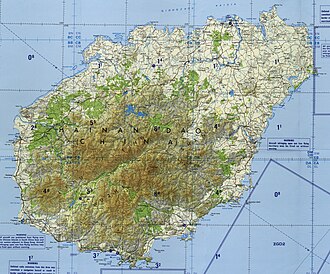
Topographic map of Hainan Island (Source: Wikipedia, n.d.) .
2. Problems and Causes
Hainan is a tropical island in southern China, so naturally it is exposed to high temperatures, heavy rainfall and detrimental typhoons. These natural issues have been long-lasting in Hainan, but as climate change exponentially increases its effects, it is only making these issues harder to manage. As Hainan continues to develop and grow, primarily in cities like Haikou and Sanya, these environmental struggles are becoming increasingly more serious and devastating.
Flooding is one of Hainan’s major problems. During their monsoon seasons, with large amounts of typhoons, a great deal of rain can fall in a very short amount of time, resulting in many floods in low-lying areas. Climate change can only make this worse, as warmer temperatures continue to rise, leading to heavier rainfall and more flooding. Aside from this, Hainan is also surrounded by the ocean which only increases the risk. Rising sea levels pose a significant threat to Hainan, as coastal communities are living under a constant risk. Flooding damages homes, roads, public spaces and other important infrastructure.
Rapid urbanisation is also a significant contributor to these problems. Hainan has experienced a major growth in population over the past few decades due to tourism and recent developments. As cities in Hainan expand, more natural land and agriculture is being replaced with grey infrastructure such as buildings, roads and concrete. In contrast to soil or plants, concrete and pavement do not absorb as much rainwater, allowing the water to run along the streets, leading to excess build-up. Similarly, wetlands significantly help absorb floodwater, protecting coastlines; however, some of these ecosystems have been damaged due to recent urbanisation and development. As natural areas fade away, coastal communities become even more prone to flooding and storm damage. Hainan relies tremendously on traditional infrastructure such as concrete drainage systems and flood walls, and while these systems are not useless, they simply are not enough to handle upcoming storms that the future entails. They are designed with the purpose of controlling water, but do not always collaborate with natural systems that can absorb and slow it down.
Overall, Hainan’s problems are caused by a combination of rapid development and climate change. Its tropical location makes it increasingly more vulnerable, while its rapid urbanisation and loss of natural ecosystems have only contributed to these risks. Due to this, Hainan needs to narrow down its focus to more flexible and resilient designs in aspects like public spacing that can protect people while working alongside the natural environment.
3. Economic, Environmental and Public Health Impacts
The Hainan province faces severe climate risks that threaten its economy, environment and public health. As the island grows rapidly, its two main cities, Haikou and Sanya, face very different dangers. To protect these cities, we must understand how weather hazards and human developments collide. The physical and economic survival of these urban areas depends on accurately mapping these risks.
Different factors affect the flood risk profiles of the two cities. First, Haikou is situated on the low ground of the Nandu River’s north coast. Because of its coastal location and due to the strong typhoons and heavy rains, it has both high hazard and exposure potential. Sanya is on the island’s southernmost tip and is protected from the north by mountain ranges. This gives Sanya a lower profile for river flooding hazard. That said, Sanya has high exposure because it is a major tourist destination. Luxury hotels and valuable shopping facilities line the narrow beach and have attracted millions of tourists.
Climate models show that if sea levels rise by 0.5 to 1.0 metres by mid-century, both cities will suffer massive losses. In Haikou, a major 1-in-100-year flood would inundate vital roads and buildings, forcing over 35% of residents to leave their homes. The financial damage would be huge, costing billions of Yuan because so many factories and shipping ports are located there. In Sanya, the flooded area might be smaller, but the economic loss would still be extreme. Floods would damage international resorts, roads and airport links, threatening the tourism industry, which brings in over 60% of Sanya’s money.
Compound flooding poses an even greater risk to Hainan during the rainy season. Compound flooding occurs when all three elements of flooding occur simultaneously: heavy rainfall, storm surges and high tides. During a typhoon simulation, ocean water begins to recede. At that point, land-based water is ejected into the ocean, where it meets a sea level at its highest point. When heavy rainfall occurs, the city’s drainage system begins to malfunction: high seawater levels block the system, trapping water, and instead of flowing to its natural outlet, water is pushed upstream into surrounding streets. This flooding also damages the environment. When too much rain enters the city sewers, the pipes overflow and dirty sewage, chemicals and plastic trash flow straight into rivers. This pollution feeds toxic algae blooms, which in turn use up all the oxygen in the water, killing fish and damaging river ecosystems.
The coast is not safe either. Hainan’s coastal areas depend on mangroves and coral reefs. Coastal development and sea level rise destroy these natural defences. As the water rises, mangroves become trapped by a condition called coastal squeeze. As this happens, mangroves have nowhere to go, and coastal erosion begins, along with the displacement of marine life. In addition, rising water temperatures bleach coral, break down reefs and increase coral loss.
Finally, climate change harms human health by creating extreme heat and spreading diseases. Heavy concrete buildings trap heat during the day and stay hot at night. This extreme heat strains the heart and lungs, especially for older adults and outdoor workers. When floods mix with this heat, the health danger grows. Stagnant water left behind by floods becomes a breeding ground for mosquitoes that carry diseases like dengue. Flooded buildings also grow mold, making urban areas unsafe and uncomfortable to live in.
4. Green Solutions
Sustainable infrastructure is central to combatting climate change, and China’s Hainan province is positioned to become a model for coastal regions worldwide. Climate resilience must be engineered into cities to adapt to a changing world: green engineering allows public environments to both absorb carbon and provide functional space for future generations. When cities grow alongside nature rather than against it, they become more resilient to climate change and improve residents’ quality of life. This section proposes how Hainan can engineer its public spaces to combat the effects of climate change through four approaches: (1) sponge city infrastructure, which builds cities to absorb water rather than intercept it; (2) coastal and ecological restoration; (3) distributed clean energy; and (4) low-carbon mobility. These solutions are most effective when pursued holistically rather than as isolated fixes; blending approaches can produce far greater reductions in carbon emissions and significant improvements in residents’ quality of life.
4.1 The Sponge City Model
One of the most effective concepts in flood-risk management and water quality is the sponge city model. Made national policy in 2015, this approach requires pilot cities to absorb, store and reuse at least 70% of on-site rainfall by treating the land itself as a filter, rather than piping water away (Zevenbergen, Fu & Pathirana, 2018). Haikou was among the original pilot cities selected to implement this infrastructure programme (Yin et al., 2022), and this approach should be extended to the province’s surrounding cities. In practice, this means replacing conventional paving with porous concrete or jointed pavers on streets and walkways, allowing water to infiltrate through the surface into a gravel base layer beneath rather than running off into storm drains. This reduces the effective impervious surface area of urban districts, cutting peak runoff volumes, and filtering out sediment and pollutants before they reach rivers, lakes and the ocean.
Increased urban vegetation such as Acacia mangium and Eucalyptus robusta can further support this goal: research on Hainan’s eroded latosol soils has found that these species build up substantial litter layers and improve soil permeability, giving them among the highest water-conservation capacities of any restoration species tested in the region (Chen et al., 2024). In the island’s interior, terraced wetlands can be constructed on sloped urban land to manage seasonal storms and maintain water quality, taking the form of a stepped sequence of shallow ponds planted with aquatic vegetation: water moves slowly downhill through each terrace, and at each step, plant roots and microbial biofilms take up nitrogen and phosphorus while suspended solids settle out. Haikou’s Fengxiang Park, along the Meishe River, is a working example of this approach: its terraced wetland cells intercept polluted urban runoff before it reaches the river, and design documentation reports measurable improvements in downstream water quality alongside increased public use of the reclaimed riverbank (Yu et al., 2019). Replicating this model along Hainan’s other waterways would allow the province to pair flood control directly with public space creation, rather than treating the two as separate projects.
4.1.1 Case Study: Haikou Meishe River Greenway and Fengxiang Park
The 13-kilometre long Meishe River has been used for the sole purpose of flood retention for many years, leading to mass pollution of the waterway. Images of black water, dead fish and concrete flood walls were broadcast nationwide on China’s national television. To combat this, nature-based solutions were implemented to transform the grey concrete river into a resilient green infrastructure, using three main strategies:
(1) Planning an ecological infrastructure. A stormwater drainage green system was employed, separating the stormwater from the sewage, to integrate the river and the wetland. While the Delft3D hydrodynamic model (Hu et al., 2025) states that the sea level for Hainan coastal areas are expected to rise by 1.1m, causing an 40% increase of flood prone areas, the stormwater drainage system can help hold up excess stormwater, drastically improving the situation.
(2) Transforming grey into green. Concrete walls were replaced with eco-friendly river banks, the city was re-connected with the ocean so tides could enter, and the shores and wetlands along the river were reconstructed to allow for the growth of mangroves.
(3) Integrating grey into green. Interconnected terraces (designed as water cleansing facilities) of constructed subsurface flow wetlands were built along the river bank, formerly occupied by a concrete flood wall and garbage dump.
Since this massive reconstruction, birds and fishes have returned, and the water has become clear again. Additionally, Haikou was honoured as one of the 18 International Wetland Cities by the Contracting Parties to the Ramsar Convention in 2018. More importantly, the project’s success highlights that nature-based solutions can play an important role in remediating water quality and floods, as well as creating public spaces that provide cultural and social services.
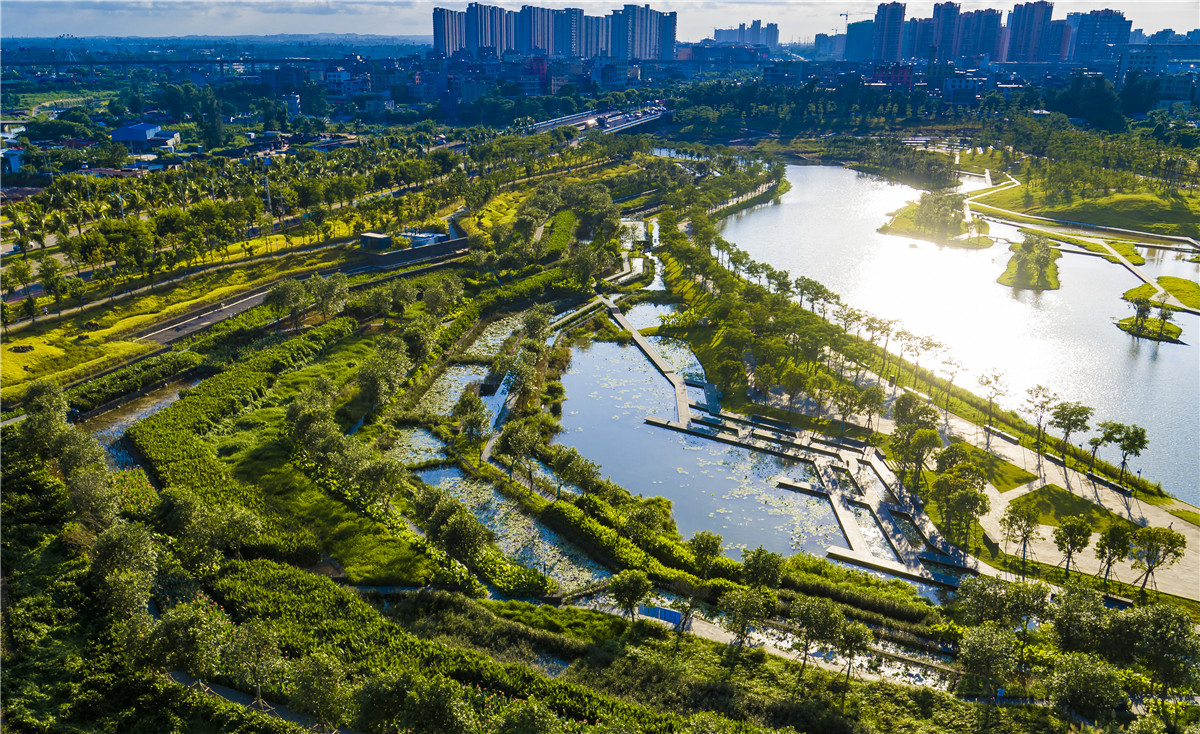
Photograph of the Haikou Meishe River Greenway and Fengxiang Park (TURENSCAPE, 2018).
4.2 Breathing Sea Wall Concept
Rigid sea walls and other impermeable coastal infrastructure pose a growing liability under climate change. Traditional hard defences reflect wave energy, which accelerates erosion, disrupts natural sediment transport and can cause water stagnation, while providing no habitat for coastal ecosystems (Perricone et al., 2023). As sea levels rise, Hainan and similar coastal regions should continue to replace these structures with breathing sea walls: terraced, planted, permeable structures filled with soil and mangrove or marsh vegetation that absorb and dissipate wave energy across a gradient rather than reflecting it off a single hard face. These structures also create intertidal habitats that strengthen regional biodiversity.
Alongside this, mangrove restoration should be prioritised along Hainan’s coastline: mangrove ecosystems sequester carbon at a rate several times higher than terrestrial forests while also trapping sediment and buffering storm surge, a function that becomes critical during the region’s typhoon season (Wang et al., 2023). Haikou’s Jiangdong Coastal Park offers a model other coastal cities in Hainan should follow: Turenscape’s redesign of a stretch of hardened Haikou coastline replaced a straight concrete flood wall with a breathing sea wall that meets flood-protection requirements while dissipating wave energy in stages and restoring intertidal habitat (Yu, 2024). Extending this approach along the rest of Hainan’s developed coastline would convert existing flood infrastructure into functioning ecosystems without weakening the flood protection it provides.
4.2.1 Case Study: The Breathing Sea Wall at Haikou Jiangdou Coastal Park
In the Hainan Free Trade zone, Haikou Jiangdong Coastal Park encompasses a stunning 370 hectares of land. However, it also faces environmental challenges. A 4-metre high concrete sea wall, originally constructed for protection, previously impeded natural sea-land interactions, leading to soil salinisation and damage to the protective vegetative windbreak. Additionally, the site was previously occupied as a shrimp farm, leaving vast areas of barren concrete ponds that replaced the native mangrove habitats.
To address these vulnerabilities, a transformative solution involving replacing the concrete wall and desolate fish farm with resilient sponge infrastructure was applied. The new infrastructure controls monsoon rainfall runoff and urban stormwater, mitigating potential salinisation. The removal of concrete revealed natural earth and enhanced ecosystem connectivity, and was repurposed for island creation and the construction of varied micro-topographies, fostering mangrove and native habitats. Mangroves serve to prevent wind and waves from storms and typhoons by absorbing the impact of high nearshore velocities that would otherwise destroy concrete walls (Hu et al., 2025).
The re-engineered Haikou Jiangdong Coastal Park serves not only as a resilient and “breathing” spongy structure against stormwater and flood, but also acts as a multi-accessible urban space. This project establishes linear pedestrian pathways to improve coastal resilience and filter storm surges, fostering vegetation growth. By merging ecological restoration of vegetative life and mangroves with urban amenities like bike lanes, trails and storm-resistant pavilions, the park allows locals, residents and tourists to enjoy an immersive experience at the redesigned landscape.
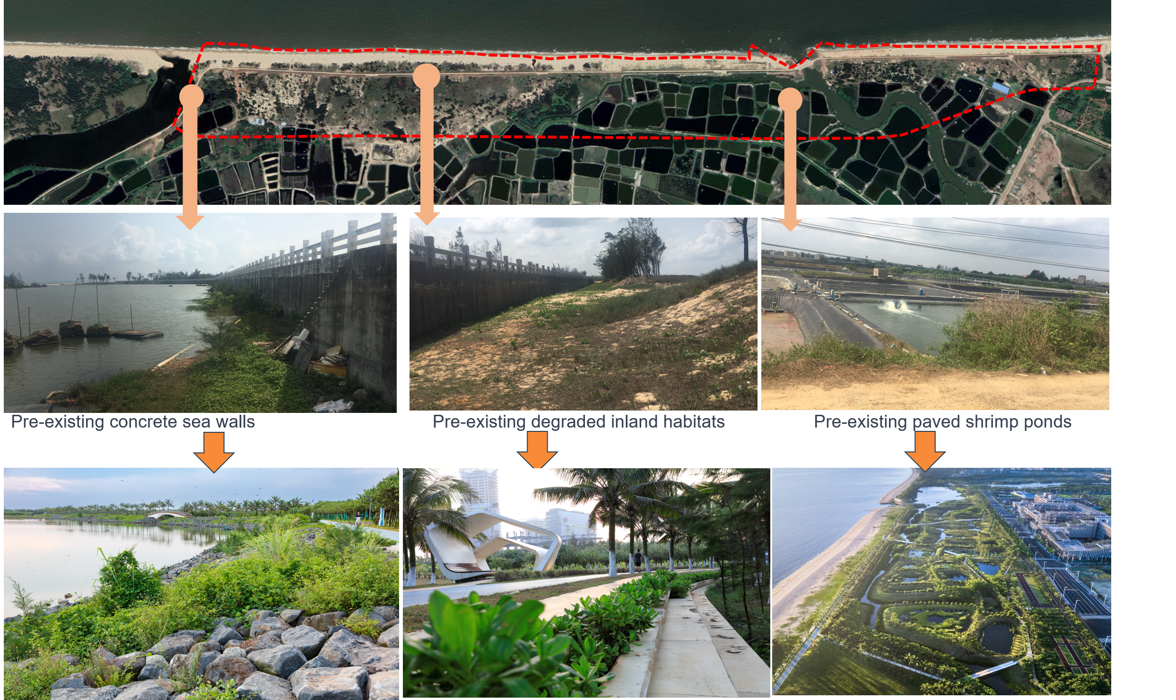
Plans for the re-construction of Haikou Jiangdong Coastal Park (TURENSCAPE, 2022)
4.3 Distributed Energy Generation
The Hainan province would also benefit from distributed energy generation: installing many small generators in places people already occupy, such as rooftops, façades and parking structures, rather than relying solely on centralised power plants. Photovoltaic cells and small wind turbines can be integrated into existing public spaces, including shading structures and walkways, without requiring new land, and fed directly into the grid. Solar panels mounted on public buildings and pavilions are especially well suited to Hainan’s tropical solar conditions. Modelling of school buildings in the province found that combining rooftop and façade photovoltaic systems, oriented south-facing at a 10–20° incline, could bring buildings close to net-zero energy consumption (Wang et al., 2024). Solar curtain walls, a form of building-integrated photovoltaics (BIPV) in which cells are laminated into a façade’s glass or cladding, offer a further option for generating power without altering a building’s footprint. Boao’s Near-Zero Carbon Demonstration Zone, on Dongyu Island, shows what this can look like at district scale: the zone integrates rooftop and façade solar, a smart microgrid and energy storage across the site so that the forum venue and surrounding public space run on an almost entirely renewable energy balance (Bowen, 2024). Hainan should treat Boao not as an isolated showcase but as a template, extending the same distributed-generation approach to other public districts across the province so that smaller communities gain direct access to clean power and the region’s overall carbon footprint falls.
4.4 Low Carbon Mobility
Within urban districts, low-carbon mobility measures, such as electricity-generating bicycles and restrictions on fuel-powered vehicles, can further increase sustainability and efficiency. Electricity-generating bicycles are shared or public bicycles fitted with pedal-driven generators that feed captured kinetic energy back into the local grid as riders use them for everyday transport, a practice already promoted within the Boao zone as part of its “green commuting” strategy (CGTN, 2025). This concept could be implemented throughout the province, as Hainan’s tropical climate is well suited to year-round cycling. Boao has also begun restricting fuel-powered vehicle access since 2025, shifting visitor and staff transport onto electric shuttles, e-bikes and generating bicycles (CGTN, 2025); given high tourist interest across the province, similar restrictions in other public and resort districts would meaningfully reduce transport emissions. This kind of district-level action would also help Hainan meet its province-wide commitment to phase out sales of new fuel-powered vehicles by 2030 (CGTN, 2026).
In conclusion, green engineering approaches, sponge city infrastructure, coastal and ecological restoration, distributed clean energy and low-carbon mobility could drastically reduce carbon emissions across Hainan province and build resilience to a changing climate. Crucially, these approaches are most powerful when pursued together: Boao already shows how energy and mobility solutions can reinforce one another within a single district, and the same integration should guide how Hainan scales these solutions province-wide. By adopting this holistic model, Hainan can prepare itself for changing weather conditions and protect its citizens’ futures.
5. Long-Term Planning
Climate change is not a short-term problem, so Hainan needs long-term strategies that continue to protect the province’s public areas even as climate risks increase. Instead of only responding to climate disasters as they happen, planning ahead is necessary to build climate resilience and to protect citizens in public spaces during the harsh weather.
To begin, one of the first problems that Hainan must address is the cost of climate-resilient development, as sustainable materials and technology can be expensive when compared to its financial returns. A suitable approach to combat this obstacle is to benefit from The Overall Plan for the Construction of Hainan’s Free Trade Port. In June 2020, China’s central government issued this plan as the foundation for transforming the island into a globally competitive free trade hub. It works as a setup that provides an opening to global businesses wishing to enter the Chinese market because of reduced barriers and an increase in policy support. One of the main pillars of Hainan’s Free Trade Port is reducing tariffs to zero, lowering the tax rates and simplifying the tax system. This rule attracts more businesses to come to Hainan and lowers the cost of sustainable materials to enter the island.
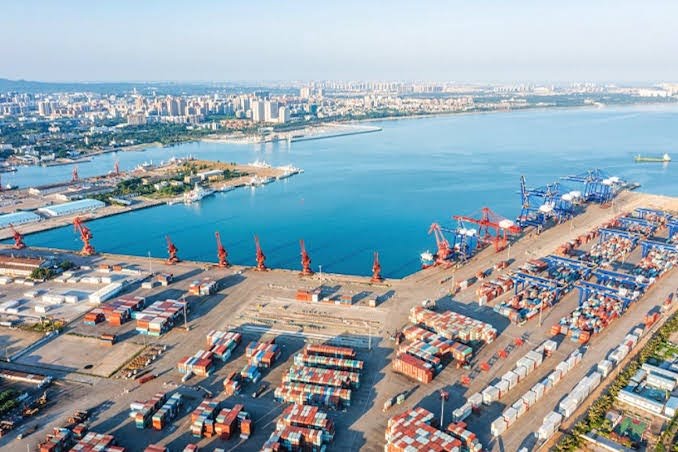
An aerial drone photo of Hainan’s Free Trade Port (VCG in Ziqi, 2025).
In order for these green spaces to be able to flourish in the long run, proper post-construction maintenance must be implemented. Post-construction guidelines are a significant process in the strengthening of building efficiency and help assist sustainability standards. Monitoring things like energy usage, emissions generation, thermal and financial performance, indoor air quality and maintenance costs are all crucial metrics in improving sustainable design. This data is critical because it can show what changes can be made in the future to improve post-construction performance. Finding out the areas that need improvement allows Hainan to set measurable goals and to use data for sustainability.
To meet the growing standards of the population with the rise of climate change, the proper funding is necessary to design green public spaces that meet these needs. Using public-private partnerships for the application of climate resilient spaces is an effective way to combat fiscal constraints and limited borrowing capacity. This will make the process easier with the private partner’s assistance in the design, financing and building of the operation. However, the partnership must be well thought out or there could be a risk in an unfair negotiation power, a loss in transparency and a liability of being locked into expensive, unadaptable contracts. On the other hand, when they are well planned, public-private partnerships can enhance the “bankability” of sustainable projects and can aid more resilient spaces and services.
Since Hainan is an island, developing tropical-specific design and material standards is necessary to ensure that efficient sustainability is achieved. People who live in tropical climates face many challenges that affect the quality of their day-to-day lives such as harsh heatwaves. Furthermore, the rapid urbanisation of Hainan has trapped heat in its cities, which can significantly impact human health, wildlife and water supply. Taking all of this into account, it becomes apparent that the design of public spaces in a tropical environment needs to meet specific standards. Developing solutions that give a standardised analysis of past case studies that apply such approaches to mitigate heat in tropical climates and classify the most impactful mitigation measures is a crucial step in the designing of buildings in Hainan.
6. Conclusion
China’s Hainan province can combat the effects of climate change by replacing traditional and concrete infrastructure with green urban spaces and sustainably engineered systems that act as a defence against floods and improve energy efficiency by utilising low-carbon mobility measures. Successful real-world case studies, such as the Haikou Jiangdong Coastal Park and Haikou Meishe River Greenway and Fengxiang Park, should be replicated across the province.
Notably, Hainan has several serious climate risks, so a multi-functional system has to be established. Nature-based solutions should be implemented across the province, including sponge infrastructure as green public spaces, which can absorb monsoon runoff with its wetlands and storm-drainage system, and “breathing” barriers that can replace concrete sea walls and rehabilitate mangroves, which in turn absorb high-velocity waves and purify sea water. Additionally, sustainably engineered public spaces should be integrated. These contain distributed energy generators, including BIPV, which integrates micro wind turbines and solar panels into existing public spaces, and low-carbon mobility measures, which include electricity generating bicycles. Finally, while the construction of new infrastructure comes with a high financial cost, by utilising The Overall Plan for the Construction of Hainan’s Free Trade Port, which implements a reduction in tax and tariffs, as well as public-private partnerships, Hainan can aid the construction of sustainably engineered projects and produce more resilient public green spaces.
Bibliography
Aili, F., Brown, V., Kapetas, L. and Gelagoti, F. (2026). Understanding Public-Private Partnerships (Resilient Cities Network).
Bowen, C. (2024) ‘Hainan showcases green transformation with near-zero carbon demonstration area’, China Daily [online]. <https://www.chinadaily.com.cn/a/202403/19/WS65f95fe8a31082fc043bd8b6.html>
Chen, S., Huang, Y., Yan, M., Han, Y., Wang, K., Chen, Z., Ruan, D., Yu, Y. and Tu, Z. (2024) ‘Differential water conservation capacity in broadleaved and mixed forest restoration in Latosol soil-eroded region, Hainan Province, China’, Plants, 13(5), 694.
CGTN (2026) ‘South China’s Hainan to steadily advance 2030 ban on sale of fuel-powered vehicles’, CGTN [online]. <https://news.cgtn.com/news/2025-03-24/Boao-forum-s-venue-island-a-pioneer-in-low-carbon-development-1BZKw6hmTTO/p.html>
CW CPA (2025) ‘Hainan Free Trade Port: Opportunities and incentives for Global Investors’, CW CPA [online]. <https://cwhkcpa.com/hainan-free-trade-port-opportunities-and-incentives-for-global-investors/>
Hu, X., Zhang, Y., Wang, L., Liu, J. and Chen, Q. (2025) ‘Sea-level rise, ENSO, and coastal flood exposure in Hainan Island: Insights from Delft3D modeling for urban adaptation’, Journal of Hydrology: Regional Studies, 57, 102145.
Long, E. (2024) ‘Using post-construction metrics to improve building efficiency‘, Building Enclosure [online]. <https://www.buildingenclosureonline.com/blogs/14-the-be-blog-building-enclosure/post/92307-using-post-construction-metrics-to-improve-building-efficiency>
Perricone, V., Mutalipassi, M., Mele, A., Buono, M., Vicinanza, D. and Contestabile, P. (2023) ‘Nature-based and bioinspired solutions for coastal protection: an overview among key ecosystems and a promising pathway for new functional and sustainable designs’, ICES Journal of Marine Science, 80(5), pp. 1218–1239.
Turenscape (2018) ‘Haikou Meishe River National Wetland Park: A Sponge City Demonstration’, TURENSCAPE.
Turenscape (2022) ‘Haikou Jiangdong Coastal Park: A Breathing Sea Wall’, TURENSCAPE.
Wang, C., Zhang, X., Chen, W., Jiang, F. and Zhao, X. (2024) ‘Multivariate evaluation of photovoltaic utilization potential of primary and secondary school buildings: a case study in Hainan Province, China’, Buildings, 14(3), 810.
Wang, F., Liu, J., Qin, G., Zhang, J., Zhou, J., Wu, J., Zhang, L., Thapa, P., Sanders, C.J., Santos, I.R., Li, X., Lin, G., Weng, Q., Tang, J., Jiao, N. and Ren, H. (2023) ‘Coastal blue carbon in China as a nature-based solution toward carbon neutrality’, The Innovation, 4(5).
Yin, D., Xu, C., Jia, H., Yang, Y., Sun, C., Wang, Q. and Liu, S. (2022) ‘Sponge city practices in China: from pilot exploration to systemic demonstration’, Water, 14(10), 1531.
Yu, K. (2024) ‘A breathing sea wall: Haikou Jiangdong Beach Park’, Landscape Architecture Frontiers, 12(1), pp. 106–109.
Yu, K., Yu, W., Lin, G., Zhang, J. and Bai, Z. (2019) ‘Slowing down nutrient flows: ecological design of the Fengxiang Park on the Meishe River in Haikou’, Landscape Architecture Frontiers, 7(6), pp. 102–115.
Zevenbergen, C., Fu, D. and Pathirana, A. (2018) ‘Transitioning to sponge cities: challenges and opportunities to address urban water problems in China’, Water, 10(9), 1230.
Ziqi, C. (2025) ‘China’s Free Trade Port heralds New Era of Openness‘, Asia Times [online]. <https://asiatimes.com/2025/12/chinas-hainan-free-trade-port-heralds-new-era-of-openness/>