
Abstract
Growing traffic congestion in cities has renewed interest in electric vertical take-off and landing (eVTOL) aircrafts to move short journeys into the air. This paper asks how electric propulsion in modern eVTOLs compares with the two traditional ways of flying, being fixed wings and helicopter rotors, and what challenges will decide whether electric flying vehicles become part of everyday travel. Drawing on technical reports, industry data and recent research, it explains how each system generates lift and how distributed electric propulsion replaces heavy shafts and gearboxes with many small motors, making eVTOLs simpler, quieter and cleaner. Then, it weighs the main barriers to adoption: limited battery energy density and range; strict safety certification; the need for vertiports and public acceptance; and high cost. The paper finds that electric propulsion offers clear advantages, but that batteries and regulation must advance before eVTOLs can carry passengers at scale.
1. Introduction
Over the past decade, significant research has gone into alternative means of air and space travel, with the purpose of finding more efficient, sustainable and less disruptive means of travel in the aviation industry. In busy cities, road congestion can turn a journey of a few miles into an hour-long trip, and while helicopters have long offered vertical flight, their cost, complexity and noise make them impractical for everyday use. This has driven interest in a new and emerging technology: electric Vertical Take-off and Landing (eVTOL) systems. eVTOL replaces heavy driveshafts, gearboxes and combustion engines with distributed electric propulsion, several small electric motors spread across the airframe, as seen in recent aircraft. The aim of this paper is to compare electric propulsion in eVTOLs with more traditional wing-based and rotor systems, and to demonstrate the growing role of electric propulsion in the aviation industry, as well as the challenges to implement eVTOL systems into our everyday travel and workflow.
2.1 Traditional Wing-Based Lift and Fixed-Wing Flight
Most conventional aircraft fly using fixed wings, from small trainers to large airliners. NASA (n.d.) explains that lift is the upward force that opposes an aircraft’s weight and holds it in the air, and that the wings produce most of the lift on a traditional aeroplane. The drawback is that lift is aerodynamic. It only appears when the aircraft is moving through the air: stop the motion and the lift disappears. As a wing moves forward, air travels faster over its curved upper surface than along the flatter underside, so the pressure on top drops below the pressure beneath, and that gap pushes the wing up. The wing also tips the oncoming air downward and, by Newton’s third law, the air pushes back with an equal upward force (NASA, n.d.). Both effects act together, and the amount of lift generated is determined by the wing’s shape and area, the air it moves through and the angle at which it meets that air – the angle of attack.
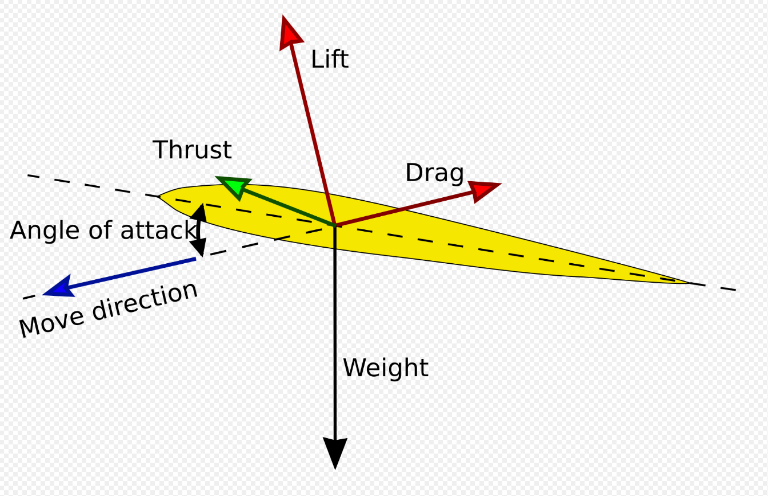
Figure 1. Different forces acting on an airborne object (Contributors to Wikimedia projects, 2026).
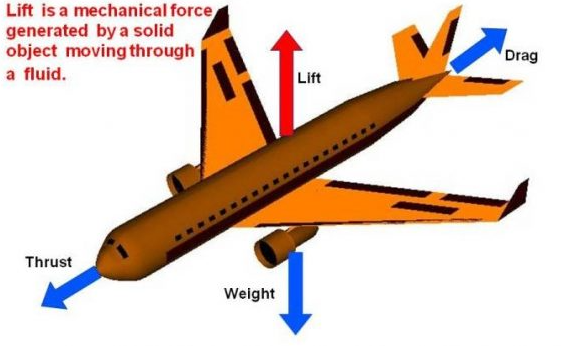
Figure 2. Example of above through an aeroplane (NASA Glenn Research Center, 2022).
As lift depends on forward speed, a fixed-wing aircraft cannot rise straight up. It must build up speed along a runway until the wings carry enough load to leave the ground, then again find a runway to land. This works well for extended trips, but it rules out hovering or lifting off from a tight space. Inside a city, where runways are scarce and most journeys are short, that is a real problem – and much of the reason designers have turned to vertical take-off instead.
2.2 Traditional Rotor Systems
A helicopter circumvents this by using one large spinning main rotor in place of fixed wings. The blades work like rotating wings, and the pilot flies the aircraft by changing their pitch – the angle they cut through the air – using a part called the swashplate. Wikibooks (n.d.) explains that the swashplate controls both the collective and cyclic pitch of the main blades. Slide it up or down the main shaft and every blade changes angle together; this is collective pitch, and it makes the rotor push air downward, so the helicopter climbs or descends (Wikibooks, n.d.). Tilt it instead, and each blade changes angle at a different point in its spin; this is cyclic pitch, and it tips the rotor, so the helicopter moves forward, backward or to either side.
Rotating a large rotor presents a second problem. As the engine drives the rotor one way, the fuselage tries to counter-rotate, so a small tail rotor sits at the back to push against that twist and keep the nose steady. The pilot operates the rear rotor with anti-torque pedals, which sit where a fixed-wing aircraft’s rudder pedals would and steer the direction the nose points (Wikibooks, n.d.). Transferring engine power to the blades requires a heavy gearbox that drops the engine’s speed from several thousand revolutions per minute to only a few hundred at the rotor and turns the tail rotor as well. This necessitates complex mechanics: a swashplate, shafts, gears and linkages. Each part adds weight and maintenance, and so electric designs aim to reduce these.
2.3 Electric Propulsion and Distributed Electric Propulsion in eVTOLs
eVTOLs depend on electric propulsion (i.e., batteries, motors) for thrust. Distributed electric propulsion (DEP) uses multiple small motors across the aircraft to maximise on efficiency, noise reduction and allow for vertical lift and horizontal cruise. Electric propulsion differs from conventional aviation propulsion and lift generation in the sense that it consists of several independent propulsors distributed across the airframe that are electronically controlled. Electric propulsion mechanisms follow a simple energy chain as compared to traditional combustion engines.
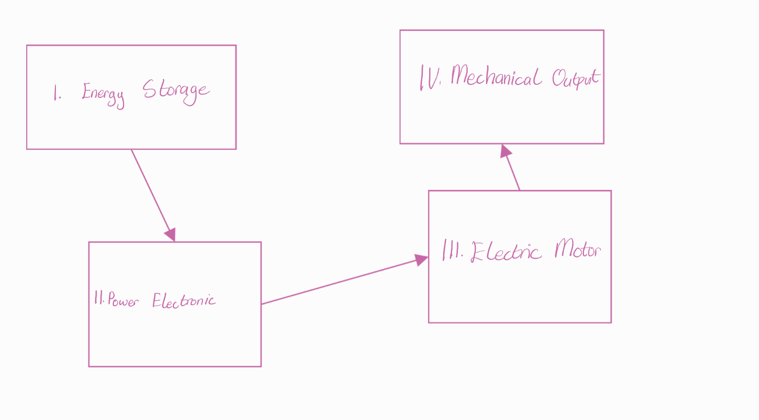
I. Energy Storage. Batteries, predominantly lithium-ion or lithium-polymer packs, store the electrical energy chemically.
II. Power Electronics. An electronic speed controller (ESC) or motor controller draws DC current from the battery and converts it into three-phase AC current to power the motor while it also regulates current, voltage and switches the frequency.
III. Electric Motor. The majority of aircrafts use a brushless DC motor (BLDC) or permanent magnet synchronous motor (PMSM). Inside, permanent magnets (rotors) and electromagnetic coils (stators) interact with each other: the controller powers the coils in a precise sequence, causing a revolving magnetic field that the permanent magnets “chase”, producing a continuous rotational torque.
IV. Mechanical Output. The aforementioned rotating shaft turns a propeller or rotor, which converts electrical energy into thrust.
2.4 eVTOL Design Configurations
In the architecture of eVTOLs, there are three main ways by which these electric propulsors are utilised:
I. Multirotor eVTOL Architecture. Multirotor architecture involves the usage of many motors and power electronic components combined with vertically oriented rotors to create lift during all phases of flight. In this scenario, lift is produced purely through thrust without reliance upon aerodynamic wings.
II. Lift and Cruise Architecture. This configuration separates the functions of vertical lift and electric propulsion. Specific lift rotors are used for take-off from a fixed set of wings, while separate propellers provide thrust during wing-borne cruise. This separation of propellers enables the aircraft to make use of aerodynamic lift from a set of fixed wings during cruise, which largely improves energy efficiency as compared to multirotor designs.
III. Tilt-Rotor Architecture. In such eVTOLs, the same propulsors are used for vertical lift and forward flight. This is achieved through the physical rotation of rotors from a vertical to a horizontal orientation through omni rotational fans. This allows for the aircraft to transition seamlessly from hover to wing-borne cruise while reducing the number of propulsion systems needed.
Irrespective of the architecture, most eVTOLs rely on distributed electric propulsion (DEP). DEP consists of the use of several smaller electric motors rather than a lone, large propulsion unit. In this system, thrust generation is distributed across three or more electric propulsors; these are fans or propellers spread in parallel along an aerodynamic surface such as a wing. These fans are connected electrically to a power source, allowing for propulsors to be placed, sized and operated much more flexibly than in conventional designs. eVTOLs route current through wires instead of routing a rotating shaft, allowing the motors to go anywhere on the airframe.
2.5 Comparison: Complexity, Noise, Efficiency, Safety and Emissions
Electric power systems (EPS) are becoming increasingly attractive for their use in aircraft for numerous reasons. EPS tend to be up to 90% efficient as compared to the 55% of current large turbofans and 35% for small turboprops (Warwick, 2020). These systems can convert over 85% of electrical energy into mechanical energy whereas combustion engines convert about 40%. Additionally, EPS require fewer moving parts and lower maintenance. Unlike combustion engines, which contain a lot of parts to function, electric motors require fewer moving parts and are much simpler than conventional engines. As a result, they often require less maintenance. DEP also proposes greater scalability for aeroplanes; very light motors can produce high power coupled with high reliability. This means that they can replace current turbines and combustion engines to create high-powered, fast-moving aircrafts that are cheap to maintain. In fact, research by NASA scientists suggests that in the next decade or two, EPS could potentially replace the turbine (Moore et al., 2014).
When it comes to operation, eVTOLs have a quieter operational volume than combustion engines. Although take-off and climb out are noisy in eVTOLs, as it still must drive a propulsor (i.e., rotor/propellor/fan), electric propulsion is quieter during taxi and cruising. Moreover, the enabling of DEP means that aircrafts can have multiple smaller rotors or fans which can be made quieter. Furthermore, lithium-ion batteries have an energy density of about 200-300 Wh/Kg, significantly lower than that of jet fuel at 12kWh/kg, making it better suited for shorter flights and urban air travel.
3.1 Battery Energy Density and Range
The single biggest thing holding eVTOLs back is the battery. Conventional lithium-ion cells store somewhere between 200 and 300 watt-hours per kilogram (Cuthrell, 2025), and because most of a flight’s energy is spent on hovering during take-off and landing, this figure sets a hard ceiling on how far the aircraft can travel. In practice, today’s pure-electric eVTOLs manage only about 50 to 100 kilometres per charge, which Xu et al. (2025) note falls short of the everyday commuting most cities require them for. Better chemistries are coming, with estimates putting batteries near 400 Wh/kg by the mid-2020s and around 500 Wh/kg in the 2030s (Cuthrell, 2025). Until they arrive, range and payload stay tightly limited. There is also a drawback that petrol aircraft are able to avoid: a battery weighs the same empty as it does full, so an electric aircraft must haul that dead weight the entire way.
3.2 Safety and Certification
Even a perfect aircraft cannot carry passengers until a regulator deems it is safe, and that step has been slow. In late 2024, the US Federal Aviation Administration (FAA) finalised its “powered lift” rules, creating the first new category of civil aircraft since helicopters arrived in the 1940s (Cuthrell, 2025). Europe took its own route with the Special Condition for VTOL aircraft, or SC-VTOL, which sorts designs into “basic” and “enhanced” classes; an enhanced air taxi flying over a crowded city has to prove a catastrophic failure rate no worse than one in a billion flight hours (eVTOL Travel, 2026). That is an extremely high bar. eVTOLs do have one thing working in their favour here: by spreading lift across many small electric motors rather than one engine and rotor, losing a single motor need not bring the aircraft down, which builds in a redundancy that a helicopter lacks (ICAO, 2025). Even so, proving all of this to several regulators who do not yet fully agree with one another is one of the biggest challenges in reaching service.
3.3 Infrastructure and Public Acceptance
Getting the aircraft certified is only half the battle; the city has to be ready for it too. eVTOLs need somewhere to land, recharge and collect passengers, and Sengupta et al. (2025) single out vertiport construction, route planning and air-traffic management as major unsolved problems, especially once many aircraft share the same crowded strip of low airspace. Building enough well-sited vertiports and fast chargers is what decides whether a service is usable day to day (Abdulla et al., 2025). Additionally, there is the public consideration. People must be willing to fly in a small, highly automated aircraft and to accept flights passing over their neighbourhoods and homes. This is why noise considerations are so important and why Joby has worked to keep its aircraft under 65 decibels on a flyover (eVTOL certification report, 2026). Accessibility counts as well: if vertiports are awkward to use for less mobile passengers, take-up falls (Abdulla et al., 2025).
3.4 Cost and Commercial Viability
Finally, the numbers must work as a business. eVTOLs are costly to build: their aviation-grade battery packs alone run three to five times the price of the batteries in an electric car (XT Battery, 2025), and developers get through huge sums before earning anything back. Lilium, one of the best-known names, spent around $1.8 billion over seven years and still went bankrupt in 2024 without getting its aircraft certified (eVTOL Certification Report, 2026). The optimism has not gone away, though. Roland Berger has projected that the urban air-mobility market could be worth as much as $90 billion a year by 2050 (Grepow, 2024). To close the gap, most operators plan to launch with premium, higher-priced trips around 2030 and shift towards cheaper ride-share pricing later, perhaps by 2035, once fleets and demand build up (Abdulla et al., 2025). Whether prices drop far enough for ordinary people to afford a regular flight is still unsettled and that is the question that decides whether eVTOLs turn into everyday transport or stay a toy for the wealthy.
4.1 Weighing the Advantages and Disadvantages
EPS has an advantage over combustion/mechanical rotor systems in terms of efficiency, simplicity and noise. The efficiency of eVTOLs is profound: electric motors can convert even more input energy into usable thrust compared to conventional combustion engines and mechanical rotor systems. This alone places eVTOL mechanisms ahead of other means of air travel by eliminating most mechanical failure points of a transmission-driven rotor system. Despite this, there is a notable limitation in the form of the battery. Most eVTOLs are limited to about 151-161 kilometres per charge. This range is good for simpler journeys – those within urban areas or across suburban settlements. However, once you consider regional connectivity, eVTOLs’ inability to cover greater journeys places a cap on the use of eVTOLs for typical commercial air travel. Fortunately, this limitation is slowly being overcome. As of 2025, eVTOL batteries surpassed 500 Wh/kg which is a drastic increase from the 200-300 Wh/kg in typical lithium-ion cells. This projects longer-range, cost-efficient travel in the future.
Despite an extensive noise reduction through the incorporation of DEP, some consumers still complain about the noise produced by these eVTOLs which have slightly hindered their adoption into urban use – what they were originally intended for. Moreover, if these aircrafts were to be adopted into urban environments, grid infrastructure will have to be upgraded to support the high power needed to charge eVTOLs. Fortunately, many regions are in the process of making these upgrades. Limited lithium availability also greatly limits production, but currently more research is going into the manufacturing of sodium ion batteries which can help relieve the pressure on the lithium industry.
In terms of efficiency, EPS is the clear choice for its maintenance, noise reduction and sustainability but currently lacks in range and energy density. However, with industry advancements in the next few years, this gap between traditional aircrafts and eVTOLs will soon close up.
4.2 Current State of the Industry
eVTOLs began as a theoretical means of travel in 2014, later evolving into something that was tested and prototyped in simple drones for farming, among other applications. In 2022, Alauda Aeronautics and other companies began to bring eVTOLs to reality through the Airspeeder MK4, the LMV 496 and the R44 Sprayhawk. Now, after years of prototypes, the industry is transitioning from certification milestones to actual commercial operations. Additionally, bodies like the FAA and the European Union Aviation Safety Agency (EASA) have introduced regulations specifically regarding eVTOLs, meaning that producers can focus less on regulation concerns and more on manufacturing.
In countries like Dubai, eVTOLs are being used for unmanned defence projects and cargo; in China, they are being used for pilotless passenger operations by companies like EHang. There are nearly 156 vertiports running currently and 350 more in development. These vertiports are currently concentrated in urban hubs.
5. Conclusion
Based on current findings, EPS far outperforms traditional mechanically-driven systems on three dimensions: energy conversion efficiency, mechanical simplicity and noise. DEP has drastically increased the amount of input energy that can be usefully converted, and its rotor architecture allows for greater aerodynamic control and reduces the failure margin. The only place in which eVTOLs lose to traditional aircrafts is in energy storage. This singular setback with current technologies is being overcome with recent research and will not be a setback for much longer. In further research, tracking battery chemistry progress will help to determine whether eVTOLs can be used for long-range travel in the future. Additionally, conducting a detailed and technical comparison of the three main eVTOL architecture will help to gauge which would be most practical for each mission type in future aircrafts.
Bibliography
Abdulla, A., Arora, Z.M., Cheung, N., Choudhary, V., Corbett, P., Gorzelak, P., Hsieh, C.Z.M., Naeem, M.A., Shen, E., Sun, H.P., Tillieux, C., Varma, A. & Westwood, E. (2025). ‘eVTOLs as Aerial Taxis in Urban Environments: Human-Centred Design and Operational Considerations for Next-Generation Air Transport’, OxJournal [online]. <https://www.oxjournal.org/evtols-as-aerial-taxis-in-urban-environments/>
Carpenter Electrification (2024). ‘Comparing electric, hybrid, and Hydrogen-Powered flight’, Carpenter Electrification [online]. <https://www.carpenterelectrification.com/blog/comparing-electric-hybrid-hydrogen>
Contributors to Wikimedia projects (2026). ‘Lift (force)’, Wikipedia [online]. <https://simple.wikipedia.org/wiki/Lift_%28force%29>
Cuthrell, S. (2025). ‘eVTOL Technology Trends To Watch in 2025’, EEPower [online]. <https://eepower.com/tech-insights/evtol-technology-trends-to-watch-in-2025/>
European Space Agency (n.d.). ‘What is Electric propulsion?’, ESA [online]. <https://www.esa.int/Enabling_Support/Space_Engineering_Technology/What_is_Electric_propulsion>
European Union Aviation Safety Agency (n.d.). EASA [online]. <https://www.easa.europa.eu/en>
eVTOL Travel (n.d.). ‘eVTOL Regulations: FAA, EASA & Global Standards’, eVTOL Travel [online]. <https://evtol.travel/evtol-regulations>
Grepow (2024). ‘Next-Generation eVTOL Battery Technology’, Grepow [online]. <https://www.grepow.com/blog/next-generation-evtol-battery-technology.html>
Intel Market Research (2026). eVTOL Battery Technology Market Growth Analysis, Dynamics, Key Players and Innovations, Outlook and Forecast 2026-2034, IMR-38248. <https://www.intelmarketresearch.com/evtol-battery-technology-market-38248>
International Coordinating Council of Aerospace Industries Associations (2025). ‘Regulatory Challenges and Harmonization Needs for Electric Vertical Take-Off and Landing (eVTOL) Certification in Advanced Air Mobility’, International Civil Aviation Organization, Working Paper A42-WP/500.
Kim, H.D., Perry, A.T. & Ansell, P.J. (2018). ‘A Review of Distributed Electric Propulsion Concepts for Air Vehicle Technology’, AIAA/IEEE Electric Aircraft Technologies Symposium, Conference Paper.
Larson, G.C. (2015). ‘Electrical power will change the look of aviation’, Smithsonian Magazine [online]. <https://www.smithsonianmag.com/air-space-magazine/NASA-electric-propulsion-180957302/>
NASA Glenn Research Center (2022). ‘What is Lift?’, National Aeronautics and Space Administration [online]. <https://www1.grc.nasa.gov/beginners-guide-to-aeronautics/what-is-lift/>
Pearson, M. (2023). ‘The MK4: the first crewed flying racing car’, Airspeeder [online]. <https://airspeeder.com/news/the-mk4-the-first-crewed-flying-racing-car>
PrivatecharterX (2025). ‘eVTOL Certification 2025: FAA Timeline for Joby & Archer’, PrivatecharterX [online]. <https://www.privatecharterx.blog/evtol-certification-2025/>
Robinson Helicopter Company (n.d.). ‘R44 Sprayhawk Unmanned Aircraft’, Robinson Unmanned [online]. <https://www.robinsonheli.com/unmanned/uas/r44-sprayhawk>
Sengupta, R., Bulusu, V., Mballo, C.E., Onat, E.B. & Cao, S. (2025). ‘Urban Air Mobility Research Challenges and Opportunities’, Annual Review of Control Robotics and Autonomous Systems, 8, pp. 407-431.
Smith, G.M. (2024). ‘Understanding EVTOL: A Complete Guide to Electric Vertical Takeoff and Landing Aircraft’, DEWESoft [online]. <https://dewesoft.com/blog/evtol-guide>
Warwick, G. (2020). ‘What Are The Advantages and Challenges of Electric-Powered Airliners?’, Aviation Week [online]. <https://aviationweek.com/aerospace/aircraft-propulsion/what-are-advantages-challenges-electric-powered-airliners>
Wikibooks (n.d.). ‘Rotorcraft Fundamentals/Helicopter Flight Controls’, Wikibooks [online]. <https://en.wikibooks.org/wiki/Rotorcraft_Fundamentals/Helicopter_Flight_Controls>
Xu, J., Guan, C., Wang, Y., Zhuang, J. & Gan, W. (2025). ‘A Systematic Review of Urban Air Mobility Development: eVTOL Drones’ Technological Challenges and Low-Altitude Policies of Shenzhen’, Drones, 9(12), 842.