
Abstract
The increasing use of artificial intelligence (AI) in the United States’ power grid creates an important engineering question: Does the energy and carbon footprint of generative and predictive AI outweigh its ability to improve power grid efficiency and renewable energy use? This issue matters as AI needs significant amounts of electricity and resources for computing, cooling and hardware, while the United States is also working to reduce carbon emissions and increase use of renewable energy. This paper investigates both the environmental costs of AI and its benefits to the power grid by reviewing scientific research and industry reports. The research found that AI and its data centres can create significant impacts to the environment through high usage of electricity, carbon emissions and water use. However, technologies such as closed-loop cooling systems and domain-specific processors can reduce the resources required by AI infrastructure. It was found that AI-powered forecasting and grid management can improve renewable energy integration, reduce energy waste, improve grid reliability and decrease reliance on fossil-fuel generation. Overall, our findings suggest that AI has a neutral environmental impact. The main conclusion is that AI can provide greater environmental benefits than its costs when it’s designed and operated efficiently, mostly through improved cooling, energy-efficient hardware and effective power grid optimisation.
Introduction
As artificial intelligence (AI) becomes increasingly integrated into the United States’ power grid, it has the potential to improve how electricity is produced and consumed. Generative and predictive AI can forecast energy demand, identify inefficiencies, manage electricity distribution and help integrate renewable sources such as solar and wind power. However, these technologies also require large amounts of electricity, creating their own carbon and energy footprint. This creates an important engineering problem: Does generative and predictive AI’s optimisation of power grid energy renewability and efficiency outweigh its own carbon and energy footprint in the United States? This issue matters because the United States is attempting to increase renewable energy use and reduce carbon emissions while electricity demand continues to grow. If AI can make the grid more efficient, it could support a cleaner and more reliable energy system; however, if AI consumes too much energy and produces significant emissions, some of these benefits could be reduced or even offset. Therefore, this paper will examine both the potential benefits and drawbacks of AI in the power grid without assuming that one outweighs the other.
Environmental Threats Posed by AI
Artificial intelligence poses environmental threats that are easy to overlook, since its damage shows up as neither smoke in the sky nor significance in a single prompt. However, advanced AI models and large data centres require an enormous amount of electricity, generated largely by the burning of fossil fuels like coal and natural gas. Excessive electricity usage and carbon emissions are due to cooling methods, manufacturing of hardware accelerators that AI models are trained on and computation (Delort et al., 2023). Due to the increased demand of data centres and more widespread use of sophisticated AI models, researchers project a dramatic increase in global electricity consumption. In 2025, data centres accounted for nearly 2% of electricity worldwide, possibly exceeding 8% by 2030 (Herrera et al., 2025), as well as around 10% of global carbon emissions (Cowls et al., 2021).
Companies have begun implementing new cooling methods, energy sources and engineering techniques to mitigate the environmental effects of artificial intelligence; however, the demand for new data centres requiring enormous amounts of electricity means that their electricity consumption has tripled since 2022 (Zewe, 2025), using as much electricity each year as more than 15% of all households in the United States combined (O’Donnell & Crownhart, 2025). The future that AI holds in regard to optimisation of processes, research, discovery, computation and more is very promising, but it is important to also recognise the pivotal role it plays on the planet.
Engineering Optimisations
While the severe power requirements of training and operating AI models raises comprehensive environmental concerns, and there is no single “silver bullet” towards decarbonisation, implementing a multitude of decarbonisation technologies can incrementally help the positives outweigh the negatives. The adoption of aggressive advanced zero water cooling and domain-specific accelerator architecture across American data centres paves a viable path towards shrinking carbon outputs.
Closed-loop cooling system: Cooling mechanisms have historically accounted for a massive proportion of facilities’ total energy consumption and resource usage. To manage the extreme thermal output of AI processing units and keep water usage at bay, modern data centres are starting to implement an advanced closed-loop liquid cooling system. Traditionally, AI processing units are cooled using an open-loop cooling system, which works by warm water absorbing heat from the units and then being cooled by an evaporation tower. The downsides to the usage of open-loop systems are high water consumption. Closed-loop cooling systems work by using sealed pipes or coils to cool the servers without directly exposing water to air. Because water is not evaporated into the environment, make-up water is needed much less than in traditional open-loop systems. Closed-loop cooling can reduce freshwater use by up to 70% (Florida et al, 2026) and increase a data centre’s water usage effectiveness (WUE) by up to 80% (Microsoft, 2024).
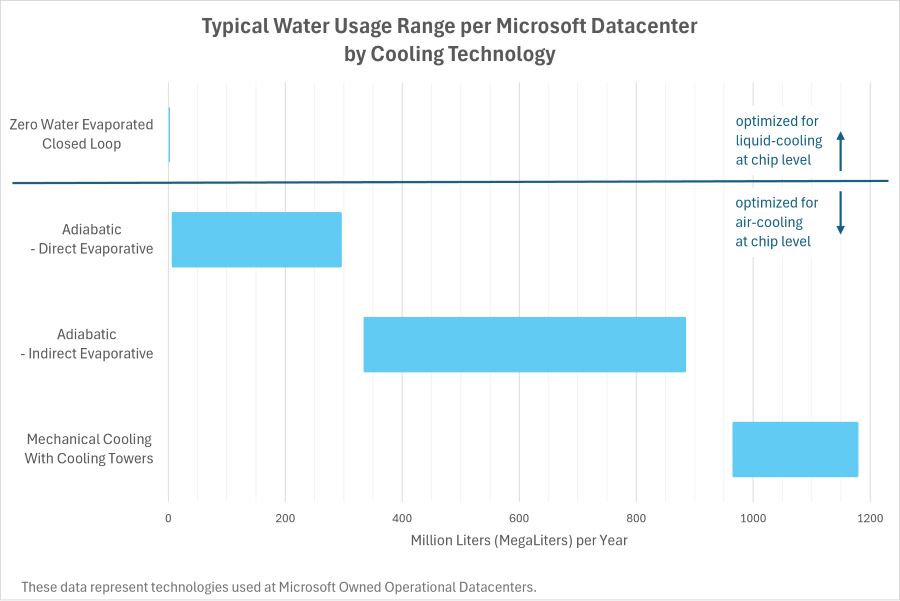
Figure 1. Typical water usage range per Microsoft datacentre by cooling technology (Solomon, S., 2024).
Domain-specific accelerators and next-generation hardware: At the semiconductor level, developments in specialised processor functionality and design play a vital role in controlling data centre energy scaling (MIT AI Hardware Program, 2025). A standard processing unit requires considerable energy to function relative to the output when processing dense linear algebra calculations needed for machine learning (IEA, 2024). In response, many modern data centre facilities are leaning towards and migrating to domain-specific hardware, graphics processing units (GPUs) and integrated circuits designed to maximise the calculations per watt (MIT AI Hardware Program, 2025). These accelerators have exponentially more value and computational power than older versions; this, in turn, reduces the energy needed to perform the basic functions as before (Shehabi, 2024). By maximising the efficiency of every megawatt drawn from the grid, smart structural designs minimise the environmental footprint of the increasing digital operations (IEA, 2024).
AI Power Grid Optimisation
Smart power grid management is arguably the most persuasive benefit of using artificial intelligence to obtain higher energy efficiency and renewability. AI contributes to power grid management in two related but diverse ways, one being through predictive AI, which forecasts demand and renewable energy generation, and the other being generative AI, which can design more efficient grid systems, automate grid balancing and more. Both of these AI types have been put into place across US grid operators increasingly over time.
Wind and solar patterns are unpredictable, which is the main grid stability problem that AI is used to help solve. New machine learning (ML) models can now forecast solar and wind output days ahead with a much lower error than original models. ML is a core component of AI where computers are trained on data and statistical algorithms to learn, improve and make decisions automatically over time. One investigation on wind forecasting found that newer ML models had a minimum performance improvement of 5% and a maximum of 20% compared to traditional recurrent neural network (RNN) models (Sarkar et al., 2023).
Google DeepMind, a leading artificial intelligence laboratory, applied ML algorithms to 700 megawatts of wind power capacity in the central United States. Researchers constituted this DeepMind system to forecast wind power output approximately 36 hours in advance of actual generation (Energetica India, 2019). These predictions have boosted the value of that wind energy by about 20% by enabling energy/power delivery to be scheduled in advance of production. So why does this matter economically and environmentally? The National Renewable Energy Laboratory’s (NREL) western wind and solar integration study found that using wind and solar forecasts that are a day ahead for grid operations would save about $5 billion per year just across the 14 state western grid (Mooney, 2010). When wind or solar energy sources unexpectedly drop, fast starting fossil fuel generators are required to be used to rapidly gain back the lost energy. These generators emit large amounts of carbon dioxide. The new accurate forecast predictions from AI also allow reserve fossil plants to be completely shut off instead of remaining idle and creating carbon emissions.
Hybrid artificial intelligence models are used to improve fault detection and grid control on the power grid. Hybrid AI models combine machine learning with traditional methods of grid optimisation. Hybrid AI learning systems are much more powerful as they have reached an accuracy of 98% when classifying faults in grids (Ahmadi et al., 2025). Adding clean energy methods to the power grid is highly complex and AI mixed with optimisation algorithms helps the grid handle the complexity. One implemented AI strategy achieved voltage stabilisation 15% faster than original methods did (ResearchGate, 2025). Energy systems managed by AI not only increase grid efficiency, but they also decrease carbon emissions. Since AI management leads to better optimised energy flow, minimised energy loss and reduced waste, less fossil fuels are burned from the non-clean energy sources, leading to lower greenhouse gas emissions from the energy field (Biswas et al., 2025).
Conclusion
Artificial intelligence demonstrates both environmental costs and the potential to improve the efficiency of the United States power grid. Research has found that AI requires large amounts of electricity and resources, with data centres contributing to energy consumption and carbon emissions through computing, cooling and hardware. However, this paper also found that technologies such as closed-loop cooling systems and domain-specific accelerators can reduce the environmental impact of AI infrastructure. At the same time, AI-powered forecasting and grid management can improve the integration of renewable energy, reduce energy waste and help limit the need for fossil-fuel generation. This means that AI’s environmental impact is not simply positive or negative; its overall value depends on how efficiently the technology is designed. This matters because the growing use of AI must be balanced with the goal of creating a more efficient power grid. For the future, data centres and power grid operators should continue implementing more efficient cooling, hardware and AI-based grid management technologies so that the benefits of AI can be increased while its environmental costs are minimised.
Bibliography
Ahmadi, M., Aly, H., & Gu, J. (2026). A comprehensive review of AI-driven approaches for smart grid stability and reliability. Renewable and Sustainable Energy Reviews, 226 [Part D], 116424.
Cowls, J., Tsamados, A., Taddeo, M. et al. (2023). The AI gambit: leveraging artificial intelligence to combat climate change—opportunities, challenges, and recommendations. AI & Society, 38, pp.283–307.
Delort, E., Riou, L., & Srivastava, A. (2023). Environmental Impact of Artificial Intelligence (INRIA: CEA Leti), pp.1-33.
Hegde, G. (2026). Myths vs. Reality: Data Centers And Water Usage. Florida Water & Pollution Control Operators Association [online]. <https://www.fwpcoa.org/content.aspx?page_id=5&club_id=859275&item_id=130961>
Herrera, M., Xie, X., & Menapace, A. (2025). Sustainable AI infrastructure: A scenario-based forecast of water footprint under uncertainty. Journal of Cleaner Production, 526, 146528.
International Energy Agency (2024). Electricity 2024. IEA [online]. <https://www.iea.org/reports/electricity-2024>
MIT AI Hardware Program (2025). Agile Design of Domain-Specific Hardware Accelerators and Compilers. MIT AI Hardware Program [online]. <https://www.aihardware.mit.edu/agile-design-of-domain-specific-hardware-accelerators-and-compilers/>
O’Donnell, J., & Crownhart, C. (2025). We did the math on AI’s energy footprint. Here’s the story you haven’t heard. MIT Technology Review [online]. <https://www.technologyreview.com/2025/05/20/1116327/ai-energy-usage-climate-footprint-big-tech/>
Office of NEPA Policy and Compliance (2024). Advanced reliability and resiliency operations for wind and solar (ARROWS). U.S. Department of Energy [online]. <https://www.energy.gov/nepa/articles/cx-030767-advanced-reliability-and-resiliency-operations-wind-and-solar-arrows>
Sarker, R., Anavatti, S., Dam, T., Pratama, M. & Al Kindhi, B. (2023). Enhancing wind power forecast precision via multi-head attention transformer: An investigation on single-step and multi-step forecasting. arXiv, 2304.10758.
Shehabi, A., Smith, S.J., Hubbard, A., et al. (2024) 2024 United States Data Center Energy Usage Report. Berkeley Lab [online]. <https://eta.lbl.gov/publications/2024-lbnl-data-center-energy-usage-report>
Solomon, S. (2024). Sustainable by Design: Next-Generation Datacenters Consume Zero Water for Cooling. The Microsoft Cloud Blog [online]. <https://www.microsoft.com/en-us/microsoft-cloud/blog/2024/12/09/sustainable-by-design-next-generation-datacenters-consume-zero-water-for-cooling/>
Zewe, A. (2025). Explained: Generative AI’s environmental impact. MIT News [online]. <https://news.mit.edu/2025/explained-generative-ai-environmental-impact-0117>